Before we study the differentiation of single-variable functions, we briefly review several foundational mathematical concepts.
Functions ¶ A function f f f X X X Y Y Y f : X → Y f: X \to Y f : X → Y exactly one element of Y Y Y X X X
Using x ∈ X x \in X x ∈ X y ∈ Y y \in Y y ∈ Y y = f ( x ) y = f(x) y = f ( x ) x x x y y y
Graphs ¶ If X X X Y Y Y graph of a function f f f ( x , y ) (x, y) ( x , y ) y = f ( x ) y = f(x) y = f ( x )
Economic convention. q = f ( p ) q = f(p) q = f ( p )
Slope ¶ The slope of a line through points ( x , y ) (x, y) ( x , y ) ( x ′ , y ′ ) (x', y') ( x ′ , y ′ )
m = y ′ − y x ′ − x . m = \frac{y' - y}{x' - x}. m = x ′ − x y ′ − y . Differentiation is the method of finding the slope of a function and is denoted by f ′ ( x ) f'(x) f ′ ( x )
Limits ¶ We say that a function f f f limit L L L x → a x \to a x → a ε > 0 \varepsilon > 0 ε > 0 δ > 0 \delta > 0 δ > 0 [1]
∣ f ( x ) − L ∣ < ε whenever 0 < ∣ x − a ∣ < δ . |f(x) - L| < \varepsilon
\quad \text{whenever} \quad
0 < |x - a| < \delta. ∣ f ( x ) − L ∣ < ε whenever 0 < ∣ x − a ∣ < δ . When this condition holds, we write
lim x → a f ( x ) = L . \lim_{x \to a} f(x) = L. x → a lim f ( x ) = L . Continuity ¶ A function f f f continuous at a a a if:[2]
f ( a ) f(a) f ( a )
lim x → a f ( x ) \lim_{x \to a} f(x) lim x → a f ( x )
lim x → a f ( x ) = f ( a ) \lim_{x \to a} f(x) = f(a) lim x → a f ( x ) = f ( a )
Derivative at a Point ¶ Let y = f ( x ) y = f(x) y = f ( x ) x x x Δ x \Delta x Δ x y y y
Δ y Δ x = f ( x + Δ x ) − f ( x ) Δ x . \frac{\Delta y}{\Delta x}
=
\frac{f(x+\Delta x) - f(x)}{\Delta x}. Δ x Δ y = Δ x f ( x + Δ x ) − f ( x ) . Derivative as a Function ¶ The derivative of f f f x x x is defined as
f ′ ( x ) = lim Δ x → 0 f ( x + Δ x ) − f ( x ) Δ x . f'(x)
=
\lim_{\Delta x \to 0}
\frac{f(x+\Delta x) - f(x)}{\Delta x}. f ′ ( x ) = Δ x → 0 lim Δ x f ( x + Δ x ) − f ( x ) . If the derivative exists for every x x x f f f f ′ ( x ) f'(x) f ′ ( x )
Geometrically, f ′ ( x ) f'(x) f ′ ( x ) f f f ( x , f ( x ) ) (x, f(x)) ( x , f ( x ))
Common notations include:
Note that what we usually think of as a variable x x x Δ x \Delta x Δ x f f f x x x f f f ( x , f ( x ) ) (x, f(x)) ( x , f ( x )) x x x x x x x x x f f f a a a f f f a a a
y = f ( a ) + f ′ ( a ) ( x − a ) y = f(a) + f'(a)(x - a) y = f ( a ) + f ′ ( a ) ( x − a ) where a , f ( a ) , and f ′ ( a ) a, f(a), \text{ and } f'(a) a , f ( a ) , and f ′ ( a ) x x x y y y
Second Derivative ¶ The second derivative is the derivative of the derivative and is written as
f ′ ′ ( x ) = d 2 f ( x ) d x 2 . f''(x)
=
\frac{d^2 f(x)}{dx^2}. f ′′ ( x ) = d x 2 d 2 f ( x ) . Economic interpretation. ln p ( t ) \ln p(t) ln p ( t )
Basic Rules of Differentiation ¶ Let y = f ( x ) y = f(x) y = f ( x )
Constant-function Rule ¶ The derivative of a contsant function y = f ( x ) = k y=f(x)=k y = f ( x ) = k
d d x ( k ) = 0. \frac{d}{dx}(k) = 0. d x d ( k ) = 0. Power-function Rule ¶ The derivative of a power function f ( x ) = x n f(x) = x^n f ( x ) = x n
d d x ( x n ) = n x n − 1 . \frac{d}{dx}(x^n) = n x^{n-1}. d x d ( x n ) = n x n − 1 . Generalized Power-function Rule ¶ When a multiplicaytive constant k k k f ( x ) = k x n f(x) = kx^n f ( x ) = k x n
d d x ( k x n ) = k n x n − 1 . \frac{d}{dx}(k x^n) = k n x^{n-1}. d x d ( k x n ) = kn x n − 1 . Logarithmic Rule ¶ The derivatice of the log-function f ( x ) = l n x f(x) = lnx f ( x ) = l n x
d d x ( ln x ) = 1 x . \frac{d}{dx}(\ln x) = \frac{1}{x}. d x d ( ln x ) = x 1 . Exponential Rule ¶ For some exponential function f ( x ) = a x f(x) = a^x f ( x ) = a x a a a
d d x ( a x ) = a x ln a . \frac{d}{dx}(a^x) = a^x \ln a. d x d ( a x ) = a x ln a . Note that a particular case of the above is
d d x e x = e x \frac{d}{d x} e^x = e^x d x d e x = e x While
d d x ln x = 1 x \frac{d}{d x} \ln x = \frac{1}{x} d x d ln x = x 1 Now, let’s consider some further useful rules of differentiation involving two or more functions of the same variable. Specifically, suppose f ( x ) f(x) f ( x ) g ( x ) g(x) g ( x ) x x x f ′ ( x ) f'(x) f ′ ( x ) g ′ ( x ) g'(x) g ′ ( x ) f ( x ) f(x) f ( x ) g ( x ) g(x) g ( x )
Sum-difference Rules ¶ The derivative of a sum (difference) of two functions is the sum (difference) of the derivatives of the two functions.
d d x [ f ( x ) ± g ( x ) ] = f ′ ( x ) ± g ′ ( x ) . \frac{d}{dx}[f(x) \pm g(x)] = f'(x) \pm g'(x). d x d [ f ( x ) ± g ( x )] = f ′ ( x ) ± g ′ ( x ) . Determine the derivative of each of the functions below.
y = 30 x + 10 y = 30x + 10 y = 30 x + 10
y = 8 x 2 − 6 x + 12 y = 8x^2 - 6x + 12 y = 8 x 2 − 6 x + 12
y = 6 y = 6 y = 6
y = 3 − 2 x 2 y = \sqrt{3} - 2x^2 y = 3 − 2 x 2
Answers
1. f ′ ( x ) = 30 2. f ′ ( x ) = 16 x − 6 3. f ′ ( x ) = 0 4. f ′ ( x ) = − 4 x 1.\; f'(x) = 30 \quad
2.\; f'(x) = 16x - 6 \quad
3.\; f'(x) = 0 \quad
4.\; f'(x) = -4x 1. f ′ ( x ) = 30 2. f ′ ( x ) = 16 x − 6 3. f ′ ( x ) = 0 4. f ′ ( x ) = − 4 x
Product Rule ¶ The derivative of the product of two (differentiable) functions is equal to the first function times the derivative of the second function plus the second function times the derivative of the first function.
d d x [ f ( x ) g ( x ) ] = f ′ ( x ) g ( x ) + f ( x ) g ′ ( x ) . \frac{d}{dx}[f(x)g(x)]
=
f'(x)g(x) + f(x)g'(x). d x d [ f ( x ) g ( x )] = f ′ ( x ) g ( x ) + f ( x ) g ′ ( x ) . Quotient Rule ¶ The derivative of the quotient of two (differentiable) functions, f ( x ) / g ( x ) f(x)/g(x) f ( x ) / g ( x )
d d x [ f ( x ) g ( x ) ] = g ( x ) f ′ ( x ) − f ( x ) g ′ ( x ) [ g ( x ) ] 2 \frac{d}{dx} \left[ \frac{f(x)}{g(x)} \right] = \frac{g(x)f'(x) - f(x)g'(x)}{[g(x)]^2} d x d [ g ( x ) f ( x ) ] = [ g ( x ) ] 2 g ( x ) f ′ ( x ) − f ( x ) g ′ ( x ) provided that g ( x ) ≠ 0 g(x) \neq 0 g ( x ) = 0 [ g ( x ) ] 2 = g 2 ( x ) [g(x)]^2 = g^2(x) [ g ( x ) ] 2 = g 2 ( x )
Differentiate the following functions with respect to x x x
y = 3 x ( 2 x − 1 ) 5 x − 2 y=\dfrac{3x(2x-1)}{5x-2} y = 5 x − 2 3 x ( 2 x − 1 )
y = 3 x ( 4 x − 5 ) 2 y=3x(4x-5)^2 y = 3 x ( 4 x − 5 ) 2
y = ( 5 x − 1 ) ( 3 x + 4 ) 3 y=(5x-1)(3x+4)^3 y = ( 5 x − 1 ) ( 3 x + 4 ) 3
y = ( 3 x − 4 ) 5 x + 1 2 x + 7 y=(3x-4)\dfrac{5x+1}{2x+7} y = ( 3 x − 4 ) 2 x + 7 5 x + 1
y = ( 8 x − 5 ) 3 7 x + 4 y=\dfrac{(8x-5)^3}{7x+4} y = 7 x + 4 ( 8 x − 5 ) 3
y = ( 3 x + 4 2 x + 5 ) 2 y=\left(\dfrac{3x+4}{2x+5}\right)^2 y = ( 2 x + 5 3 x + 4 ) 2
Answers
1. y ′ = 30 x 2 − 24 x + 6 ( 5 x − 2 ) 2 2. y ′ = 144 x 2 − 240 x + 75 3. y ′ = ( 45 x − 9 ) ( 3 x + 4 ) 2 + 5 ( 3 x + 4 ) 3 4. y ′ = 30 x 2 + 210 x − 111 ( 2 x + 7 ) 2 5. y ′ = ( 168 x + 96 ) ( 8 x − 5 ) 2 − 7 ( 8 x − 5 ) 3 ( 7 x + 4 ) 2 6. y ′ = 42 x + 56 ( 2 x + 5 ) 3 1.\; y'=\frac{30x^2-24x+6}{(5x-2)^2} \quad
2.\; y'=144x^2-240x+75 \quad
3.\; y'=(45x-9)(3x+4)^2+5(3x+4)^3 \quad
4.\; y'=\frac{30x^2+210x-111}{(2x+7)^2} \quad
5.\; y'=\frac{(168x+96)(8x-5)^2-7(8x-5)^3}{(7x+4)^2} \quad
6.\; y'=\frac{42x+56}{(2x+5)^3} 1. y ′ = ( 5 x − 2 ) 2 30 x 2 − 24 x + 6 2. y ′ = 144 x 2 − 240 x + 75 3. y ′ = ( 45 x − 9 ) ( 3 x + 4 ) 2 + 5 ( 3 x + 4 ) 3 4. y ′ = ( 2 x + 7 ) 2 30 x 2 + 210 x − 111 5. y ′ = ( 7 x + 4 ) 2 ( 168 x + 96 ) ( 8 x − 5 ) 2 − 7 ( 8 x − 5 ) 3 6. y ′ = ( 2 x + 5 ) 3 42 x + 56
Use the quotient rule to differentiate each function.
f ( x ) = 2 x + 7 x 2 − 1 f(x)=\dfrac{2x+7}{x^2-1} f ( x ) = x 2 − 1 2 x + 7
f ( x ) = b x 3 + c x 2 + x − 4 x f(x)=\dfrac{bx^3+cx^2+x-4}{x} f ( x ) = x b x 3 + c x 2 + x − 4
f ( x ) = e 2 x x 2 f(x)=\dfrac{e^{2x}}{x^2} f ( x ) = x 2 e 2 x
f ( x ) = ( 3 x + 2 ) 2 x f(x)=\dfrac{(3x+2)^2}{x} f ( x ) = x ( 3 x + 2 ) 2
Answers
1. f ′ ( x ) = − 2 x 2 − 14 x − 2 ( x 2 − 1 ) 2 2. f ′ ( x ) = 2 b x 3 + c x 2 + 4 x 2 3. f ′ ( x ) = 2 x e 2 x − 2 e 2 x x 3 4. f ′ ( x ) = 9 x 2 − 4 x 2 1.\; f'(x)=\frac{-2x^2-14x-2}{(x^2-1)^2} \quad
2.\; f'(x)=\frac{2bx^3+cx^2+4}{x^2} \\[6pt]
3.\; f'(x)=\frac{2xe^{2x}-2e^{2x}}{x^3} \quad
4.\; f'(x)=\frac{9x^2-4}{x^2} 1. f ′ ( x ) = ( x 2 − 1 ) 2 − 2 x 2 − 14 x − 2 2. f ′ ( x ) = x 2 2 b x 3 + c x 2 + 4 3. f ′ ( x ) = x 3 2 x e 2 x − 2 e 2 x 4. f ′ ( x ) = x 2 9 x 2 − 4
Second Derivatives
Find the second derivative of each function.
y = 9 − 3 x + 7 x 2 − x 3 y = 9 - 3x + 7x^2 - x^3 y = 9 − 3 x + 7 x 2 − x 3
y = 4 x + 5 x y = \dfrac{4x+5}{x} y = x 4 x + 5
y = ln ( 4 x ) y = \ln(4x) y = ln ( 4 x )
y = x 2 e x y = x^2 e^x y = x 2 e x
y = ( x − 6 ) 4 y = (x-6)^4 y = ( x − 6 ) 4
Answers
1. y ′ ′ = 14 − 6 x 2. y ′ ′ = 10 x − 3 3. y ′ ′ = − x − 2 4. y ′ ′ = 2 e x + 4 x e x + x 2 e x 5. y ′ ′ = 12 ( x − 6 ) 2 1.\; y'' = 14 - 6x \quad
2.\; y'' = 10x^{-3} \quad
3.\; y'' = -x^{-2} \quad
4.\; y'' = 2e^x + 4xe^x + x^2 e^x \quad
5.\; y'' = 12(x-6)^2 1. y ′′ = 14 − 6 x 2. y ′′ = 10 x − 3 3. y ′′ = − x − 2 4. y ′′ = 2 e x + 4 x e x + x 2 e x 5. y ′′ = 12 ( x − 6 ) 2
Chain Rule ¶ If z = f ( y ) z = f(y) z = f ( y ) y = g ( x ) y = g(x) y = g ( x )
d z d x = d z d y d y d x . \frac{dz}{dx}
=
\frac{dz}{dy}\frac{dy}{dx}. d x d z = d y d z d x d y . The chain rule provides a convenient way to study how one variable (say, x x x z z z y y y
Sometimes, we can write for a composite function y = f ( g ( x ) ) y = f(g(x)) y = f ( g ( x ))
d y d x = f ′ ( g ( x ) ) ⋅ g ′ ( x ) \frac{dy}{dx} = f'(g(x)) \cdot g'(x) d x d y = f ′ ( g ( x )) ⋅ g ′ ( x ) Chain Rule for Exponential and Logarithmic Functions ¶ The general exponential function rule ¶ d d x e g ( x ) = e g ( x ) g ′ ( x ) \frac{d}{d x} e^{g(x)} = e^{g(x)} g'(x) d x d e g ( x ) = e g ( x ) g ′ ( x ) For example:
d d x e a x = d d ( a x ) e a x d d x ( a x ) = e a x a = a e a x \frac{d}{d x} e^{ax} = \frac{d}{d (ax)} e^{ax} \frac{d}{d x} (ax) = e^{ax} a = ae^{ax} d x d e a x = d ( a x ) d e a x d x d ( a x ) = e a x a = a e a x If we are using a base other than e e e
d d x ( a g ( x ) ) = a g ( x ) g ′ ( x ) ln a , where a > 0 , a ≠ 0 \frac {d}{d x}(a^{g(x)}) = a^{g(x)} g'(x) \ln a, \text{ where } a > 0, a \neq 0 d x d ( a g ( x ) ) = a g ( x ) g ′ ( x ) ln a , where a > 0 , a = 0 The general natural logarithmic function rule ¶ d d x ln ( g ( x ) ) = g ′ ( x ) g ( x ) \frac{d}{d x} \ln(g(x)) = \frac{g'(x)}{g(x)} d x d ln ( g ( x )) = g ( x ) g ′ ( x ) Interestingly:
d d x ln ( a x ) = d d ( a x ) ln ( a x ) d d x ( a x ) = 1 a x a = 1 / x \frac{d}{d x} \ln(ax) = \frac{d}{d(ax)} \ln(ax) \frac{d}{d x}(ax) = \frac{1}{ax} a = 1/x d x d ln ( a x ) = d ( a x ) d ln ( a x ) d x d ( a x ) = a x 1 a = 1/ x while
d d x ln ( x 2 ) = d d ( x 2 ) ln ( x 2 ) d d x ( x 2 ) = 1 x 2 2 x = 2 / x \frac{d}{d x} \ln(x^2) = \frac{d}{d(x^2)} \ln(x^2) \frac{d}{d x}(x^2) = \frac{1}{x^2} 2x = 2/x d x d ln ( x 2 ) = d ( x 2 ) d ln ( x 2 ) d x d ( x 2 ) = x 2 1 2 x = 2/ x Note also when considered base other than e e e
log b ( x ) = ln ( x ) ln ( b ) \log_b(x) = \frac{\ln(x)}{\ln(b)} log b ( x ) = ln ( b ) ln ( x ) we have
d d x log b ( x ) = 1 x 1 ln ( b ) \frac{d}{d x} \log_b(x) = \frac{1}{x} \frac{1}{\ln(b)} d x d log b ( x ) = x 1 ln ( b ) 1 Or more generally:
d d x log b g ( x ) = g ′ ( x ) g ( x ) 1 ln b , where b > 0 , b ≠ 1 = g ′ ( x ) g ( x ) log b e \begin{aligned}
\frac{d}{d x} \log_b g(x) &= \frac{g'(x)}{g(x)} \frac{1}{\ln b}, \text{ where } b > 0, b \neq 1 \\
&= \frac{g'(x)}{g(x)} \log_b e
\end{aligned} d x d log b g ( x ) = g ( x ) g ′ ( x ) ln b 1 , where b > 0 , b = 1 = g ( x ) g ′ ( x ) log b e Note that log b e = 1 ln b \log_b e = \displaystyle \frac{1}{\ln b} log b e = ln b 1
Exponential Functions
Use the rules of differentiating exponential functions to find the derivative with respect to x x x
y = x 2 e 5 x y = x^2 e^{5x} y = x 2 e 5 x
y = e 5 x − 1 e 5 x + 1 y = \dfrac{e^{5x}-1}{e^{5x}+1} y = e 5 x + 1 e 5 x − 1
y = a 2 x y = a^{2x} y = a 2 x
y = a 5 x 2 y = a^{5x^2} y = a 5 x 2
y = 4 2 x + 7 y = 4^{2x+7} y = 4 2 x + 7
y = x 3 2 x y = x^3 2^x y = x 3 2 x
Answers
1. y ′ = x e 5 x ( 5 x + 2 ) 2. y ′ = 10 e 5 x ( e 5 x + 1 ) 2 3. y ′ = 2 a 2 x ln a 4. y ′ = 10 x a 5 x 2 ln a 5. y ′ = 2 ln ( 4 ) 4 2 x + 7 6. y ′ = x 2 2 x ( x ln 2 + 3 ) 1.\; y' = x e^{5x}(5x+2) \quad
2.\; y' = \frac{10e^{5x}}{(e^{5x}+1)^2} \quad
3.\; y' = 2a^{2x}\ln a \quad
4.\; y' = 10x\,a^{5x^2}\ln a \quad
5.\; y' = 2\ln(4)\,4^{2x+7} \quad
6.\; y' = x^2 2^x(x\ln 2 + 3) 1. y ′ = x e 5 x ( 5 x + 2 ) 2. y ′ = ( e 5 x + 1 ) 2 10 e 5 x 3. y ′ = 2 a 2 x ln a 4. y ′ = 10 x a 5 x 2 ln a 5. y ′ = 2 ln ( 4 ) 4 2 x + 7 6. y ′ = x 2 2 x ( x ln 2 + 3 )
Logarithmic Functions
Use the rules of differentiating logarithms to find the derivative of each function.
f ( x ) = x − 4 + ln ( a x ) f(x)=x^{-4}+\ln(ax) f ( x ) = x − 4 + ln ( a x )
f ( x ) = 4 x 3 ln x 2 f(x)=4x^3\ln x^2 f ( x ) = 4 x 3 ln x 2
f ( x ) = ln x − ln ( 1 + x ) f(x)=\ln x-\ln(1+x) f ( x ) = ln x − ln ( 1 + x )
f ( x ) = ln ( 2 x 2 5 x ) f(x)=\ln\!\left(\dfrac{2x^2}{5x}\right) f ( x ) = ln ( 5 x 2 x 2 )
f ( x ) = log 2 ( 6 x ) f(x)=\log_2(6x) f ( x ) = log 2 ( 6 x )
f ( x ) = log 4 ( 9 x 3 ) f(x)=\log_4(9x^3) f ( x ) = log 4 ( 9 x 3 )
Answers
1. f ′ ( x ) = − 4 x − 5 + x − 1 2. f ′ ( x ) = 8 x 2 + 24 x 2 ln x 3. f ′ ( x ) = 1 x ( 1 + x ) 4. f ′ ( x ) = 1 x 5. f ′ ( x ) = 1 x ln 2 6. f ′ ( x ) = 3 x ln 4 1.\; f'(x)=-4x^{-5}+x^{-1} \quad
2.\; f'(x)=8x^2+24x^2\ln x \quad
3.\; f'(x)=\frac{1}{x(1+x)} \quad
4.\; f'(x)=\frac{1}{x} \quad
5.\; f'(x)=\frac{1}{x\ln 2} \quad
6.\; f'(x)=\frac{3}{x\ln 4} 1. f ′ ( x ) = − 4 x − 5 + x − 1 2. f ′ ( x ) = 8 x 2 + 24 x 2 ln x 3. f ′ ( x ) = x ( 1 + x ) 1 4. f ′ ( x ) = x 1 5. f ′ ( x ) = x l n 2 1 6. f ′ ( x ) = x l n 4 3
Chain Rule
Use the chain rule to find the derivative, f ′ ( x ) f'(x) f ′ ( x )
f ( x ) = ( x + 1 ) 3 + ( x 2 − 2 x ) 2 − 5 f(x) = (x + 1)^3 + (x^2 - 2x)^2 - 5 f ( x ) = ( x + 1 ) 3 + ( x 2 − 2 x ) 2 − 5
f ( x ) = ( 2 x + 4 ) 99 f(x) = (2x + 4)^{99} f ( x ) = ( 2 x + 4 ) 99
f ( x ) = ( 5 x 2 + 10 x + 3 ) 20 f(x) = (5x^2 + 10x + 3)^{20} f ( x ) = ( 5 x 2 + 10 x + 3 ) 20
f ( x ) = ( e x ) a b f(x) = (e^x)^{ab} f ( x ) = ( e x ) ab
f ( x ) = ( e x a ) b f(x) = (e^{x^a})^{b} f ( x ) = ( e x a ) b
f ( x ) = ( e a + b x + c x 2 ) 10 f(x) = (e^{a + bx + cx^2})^{10} f ( x ) = ( e a + b x + c x 2 ) 10
Answers
1. f ′ ( x ) = 4 x 3 − 9 x 2 + 14 x + 3 2. f ′ ( x ) = 198 ( 2 x + 4 ) 98 3. f ′ ( x ) = ( 200 x + 200 ) ( 5 x 2 + 10 x + 3 ) 19 4. f ′ ( x ) = a b e a b x 5. f ′ ( x ) = a b x a − 1 e b x a 6. f ′ ( x ) = 10 ( b + 2 c x ) ( e a + b x + c x 2 ) 10 1.\; f'(x)=4x^3-9x^2+14x+3 \quad
2.\; f'(x)=198(2x+4)^{98} \quad
3.\; f'(x)=(200x+200)(5x^2+10x+3)^{19} \\[6pt]
4.\; f'(x)=ab\,e^{abx} \quad
5.\; f'(x)=ab\,x^{a-1}e^{bx^a} \quad
6.\; f'(x)=10(b+2cx)(e^{a+bx+cx^2})^{10} 1. f ′ ( x ) = 4 x 3 − 9 x 2 + 14 x + 3 2. f ′ ( x ) = 198 ( 2 x + 4 ) 98 3. f ′ ( x ) = ( 200 x + 200 ) ( 5 x 2 + 10 x + 3 ) 19 4. f ′ ( x ) = ab e ab x 5. f ′ ( x ) = ab x a − 1 e b x a 6. f ′ ( x ) = 10 ( b + 2 c x ) ( e a + b x + c x 2 ) 10
Derivatives of Exponential and Logarithmic Functions
1. Exponential Rule with Base a a a
Problem: Find the derivative of f ( x ) = 5 x 3 + 2 x f(x) = 5^{x^3 + 2x} f ( x ) = 5 x 3 + 2 x
Solution:
Using the rule d d x ( a g ( x ) ) = a g ( x ) g ′ ( x ) ln a \frac{d}{d x}(a^{g(x)}) = a^{g(x)} g'(x) \ln a d x d ( a g ( x ) ) = a g ( x ) g ′ ( x ) ln a
f ′ ( x ) = 5 x 3 + 2 x ⋅ ( 3 x 2 + 2 ) ⋅ ln 5 f'(x) = 5^{x^3 + 2x} \cdot (3x^2 + 2) \cdot \ln 5 f ′ ( x ) = 5 x 3 + 2 x ⋅ ( 3 x 2 + 2 ) ⋅ ln 5 General Natural Logarithmic Rule
Problem: Find the derivative of f ( x ) = ln ( sin ( x ) ) f(x) = \ln(\sin(x)) f ( x ) = ln ( sin ( x ))
Solution:
Using the rule d d x ln ( g ( x ) ) = g ′ ( x ) g ( x ) \frac{d}{d x} \ln(g(x)) = \frac{g'(x)}{g(x)} d x d ln ( g ( x )) = g ( x ) g ′ ( x )
f ′ ( x ) = cos ( x ) sin ( x ) = cot ( x ) f'(x) = \frac{\cos(x)}{\sin(x)} = \cot(x) f ′ ( x ) = sin ( x ) cos ( x ) = cot ( x ) Logarithm with Base b b b
Problem: Find the derivative of f ( x ) = log 10 ( x 2 + 1 ) f(x) = \log_{10}(x^2 + 1) f ( x ) = log 10 ( x 2 + 1 )
Solution:
Using the rule d d x log b g ( x ) = g ′ ( x ) g ( x ) ln b \frac{d}{d x} \log_b g(x) = \frac{g'(x)}{g(x) \ln b} d x d log b g ( x ) = g ( x ) l n b g ′ ( x )
f ′ ( x ) = 2 x ( x 2 + 1 ) ln ( 10 ) f'(x) = \frac{2x}{(x^2 + 1) \ln(10)} f ′ ( x ) = ( x 2 + 1 ) ln ( 10 ) 2 x Comparison of ln ( a x ) \ln(ax) ln ( a x ) ln ( x n ) \ln(x^n) ln ( x n )
Problem: Differentiate y = ln ( 7 x ) y = \ln(7x) y = ln ( 7 x ) y = ln ( x 7 ) y = \ln(x^7) y = ln ( x 7 )
Case A: For ln ( 7 x ) \ln(7x) ln ( 7 x ) a = 7 a=7 a = 7
d y d x = 7 7 x = 1 x \frac{dy}{dx} = \frac{7}{7x} = \frac{1}{x} d x d y = 7 x 7 = x 1 Case B: For ln ( x 7 ) \ln(x^7) ln ( x 7 ) n = 7 n=7 n = 7
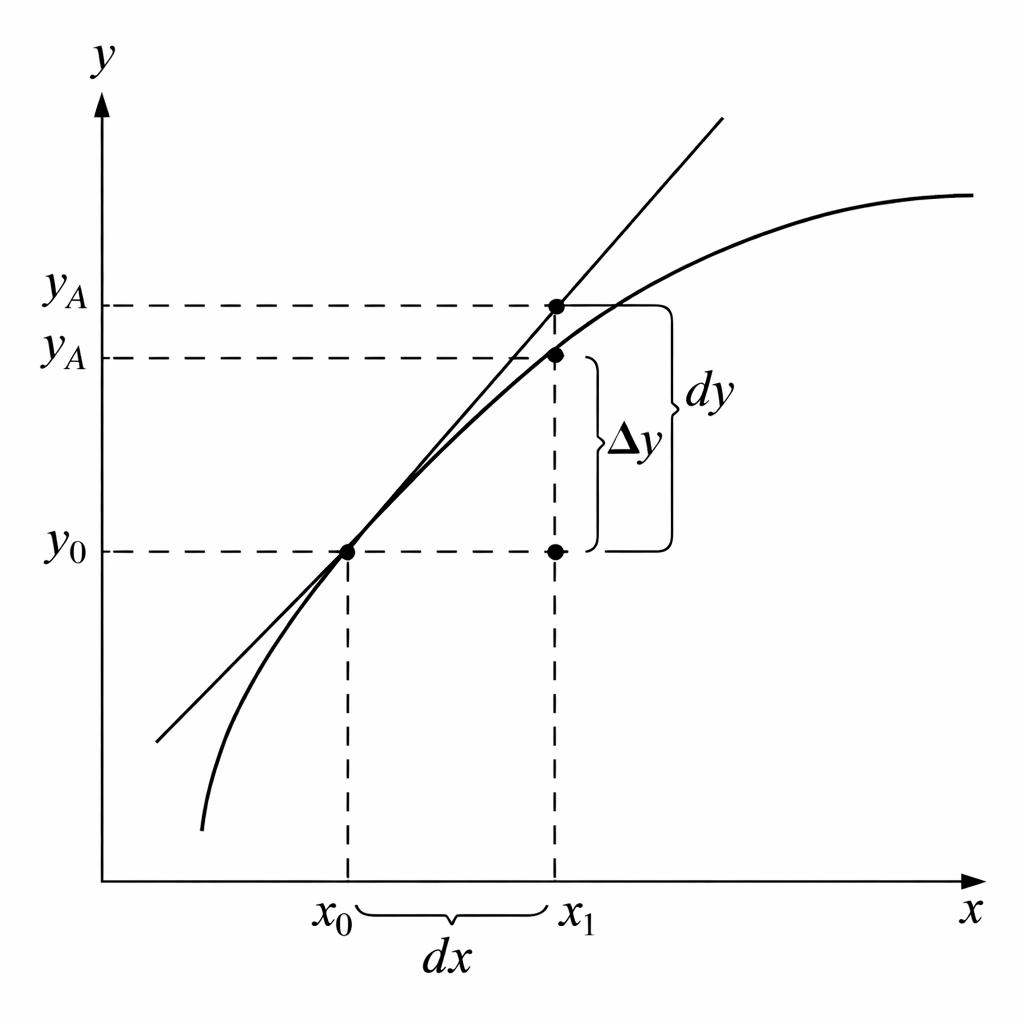
d y d x = 7 x 6 x 7 = 7 x \frac{dy}{dx} = \frac{7x^6}{x^7} = \frac{7}{x} d x d y = x 7 7 x 6 = x 7 The Differential ¶ Define d x dx d x x x x x 0 x_0 x 0 d y dy d y y y y along the tangent line from the initial value of the function y 0 = f ( x 0 ) y_0 = f(x_0) y 0 = f ( x 0 )
The differential of y = f ( x 0 ) y=f(x_0) y = f ( x 0 ) x 0 x_0 x 0
d y = f ′ ( x 0 ) d x . dy = f'(x_0)\, dx. d y = f ′ ( x 0 ) d x . This represents the change in y y y x 0 x_0 x 0 Figure 1
Figure 1: Differential
Differentials
Find the differential d y dy d y x x x d x dx d x
y = 7 x 2 − 3 x + 5 y = 7x^2 - 3x + 5 y = 7 x 2 − 3 x + 5
y = 10 x − 1 4 x 2 y = 10x - \dfrac14 x^2 y = 10 x − 4 1 x 2
y = − x 2 y = -x^2 y = − x 2
y = x 3 + 3 x − 6 y = x^3 + 3x - 6 y = x 3 + 3 x − 6
Answers
1. d y = ( 14 x − 3 ) d x 2. d y = ( 10 − 1 2 x ) d x 3. d y = ( − 2 x ) d x 4. d y = ( 3 x 2 + 3 ) d x 1.\; dy = (14x - 3)\,dx \quad
2.\; dy = \left(10 - \tfrac12 x\right)dx \quad
3.\; dy = (-2x)\,dx \quad
4.\; dy = (3x^2 + 3)\,dx 1. d y = ( 14 x − 3 ) d x 2. d y = ( 10 − 2 1 x ) d x 3. d y = ( − 2 x ) d x 4. d y = ( 3 x 2 + 3 ) d x
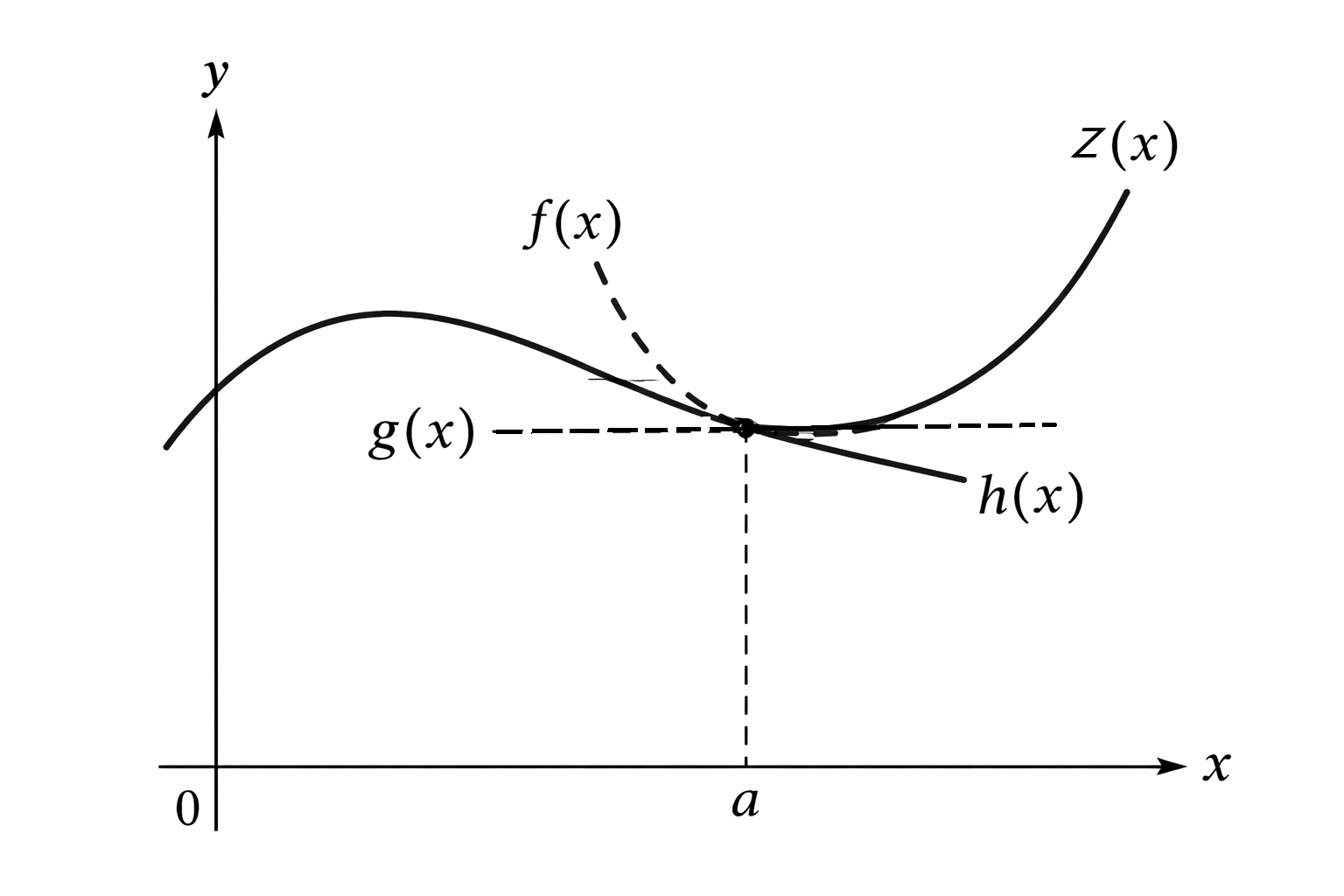
Taylor Series ¶ A smooth complex function z ( x ) z(x) z ( x ) x = a x=a x = a
f ( x ) = z ( a ) + z ′ ( a ) ( x − a ) + 1 2 z ′ ′ ( a ) ( x − a ) 2 + 1 6 f ′ ′ ′ ( a ) ( x − a ) 3 + ⋯ f(x)
=
z(a)
+ z'(a)(x-a)
+ \frac{1}{2}z''(a)(x-a)^2
+ \frac{1}{6}f'''(a)(x-a)^3
+ \cdots f ( x ) = z ( a ) + z ′ ( a ) ( x − a ) + 2 1 z ′′ ( a ) ( x − a ) 2 + 6 1 f ′′′ ( a ) ( x − a ) 3 + ⋯ This idea underlies many approximation methods in economics.
Figure 2: Taylor expansion of a smooth function around a point.
As shown in Figure 2 z ( x ) z(x) z ( x ) x = a x=a x = a
The simplest approximation perhaps would simply be g ( x ) = a g(x) = a g ( x ) = a a a a
A better approximation would be a linear function of the form h ( x ) = z ( a ) + b ( x − a ) h(x) = z(a) + b(x-a) h ( x ) = z ( a ) + b ( x − a ) b b b b b b x = a x = a x = a linear approximation to the function around this point would be
h ( x ) = z ( a ) + z ′ ( a ) ( x − a ) h(x) = z(a) + z'(a)(x-a) h ( x ) = z ( a ) + z ′ ( a ) ( x − a ) where z ′ ( a ) z'(a) z ′ ( a ) x = a x=a x = a
But why stop here? We could improve on this. A better approximation could allow for some curvature. The general form would then be, say, f ( x ) = z ( a ) + z ′ ( a ) . ( x − a ) + c . ( x − a ) 2 f(x) = z(a) + z'(a) .(x-a) + c.(x-a)^2 f ( x ) = z ( a ) + z ′ ( a ) . ( x − a ) + c . ( x − a ) 2 c c c a a a z ( x ) z(x) z ( x ) 2 c 2c 2 c f ′ ′ ( x ) f''(x) f ′′ ( x ) z ′ ′ ( x ) z''(x) z ′′ ( x ) x = a x = a x = a c = 1 / 2 z ′ ′ ( a ) c = 1/2 z''(a) c = 1/2 z ′′ ( a ) quadratic approximation to the function aound x = a x = a x = a
f ( x ) = z ( a ) + z ′ ( a ) ( x − a ) + 1 2 f ′ ′ ( a ) ( x − a ) 2 f(x) = z(a) + z'(a)(x-a) + \frac{1}{2}f''(a)(x-a)^2 f ( x ) = z ( a ) + z ′ ( a ) ( x − a ) + 2 1 f ′′ ( a ) ( x − a ) 2 Exteding the above argument for cubic and higher-degree approximations, we could find the n n n z ( x ) z(x) z ( x ) m ( x ) m(x) m ( x ) x = a x = a x = a
m ( x ) = z ( a ) 0 ! + z ′ ( a ) 1 ! ( x − a ) + z ′ ′ ( a ) 2 ! ( x − a ) 2 + ⋯ + f ( n ) ( a ) n ! ( x − a ) n m(x)
=
\frac{z(a)}{0!}
+ \frac{z'(a)}{1!}(x-a)
+ \frac{z''(a)}{2!}(x-a)^2
+ \cdots
+ \frac{f^{(n)}(a)}{n!}(x-a)^n m ( x ) = 0 ! z ( a ) + 1 ! z ′ ( a ) ( x − a ) + 2 ! z ′′ ( a ) ( x − a ) 2 + ⋯ + n ! f ( n ) ( a ) ( x − a ) n where f ( n ) ( a ) f^{(n)}(a) f ( n ) ( a ) n n n z ( x ) z(x) z ( x ) x = a x = a x = a m ( x ) m(x) m ( x ) n n n z ( x ) z(x) z ( x ) x = a x=a x = a
To sum, z ( x ) z(x) z ( x ) g ( x ) g(x) g ( x ) h ( x ) h(x) h ( x ) z ( x ) z(x) z ( x ) x = a x=a x = a z ( x ) z(x) z ( x ) x = a x=a x = a f ( x ) f(x) f ( x ) f ( x ) = z ( a ) + z ′ ( a ) ( x − a ) + 1 2 z ′ ′ ( a ) ( x − a ) 2 f(x) = z(a) + z^{\prime }(a)(x-a) + \frac{1}{2} z''(a)(x-a)^2 f ( x ) = z ( a ) + z ′ ( a ) ( x − a ) + 2 1 z ′′ ( a ) ( x − a ) 2 x = a x=a x = a z ( x ) z(x) z ( x ) x = a x=a x = a h ( x ) h(x) h ( x ) g ( a ) g(a) g ( a ) x = a x=a x = a
For example, consider the function
y = e x / 2 − e − x / 2 , y = e^{x/2} - e^{-x/2}, y = e x /2 − e − x /2 , expanded around the point x = 2 x = 2 x = 2
Linear approximation
The linear approximation to this function is
h ( x ) = ( e 1 − e − 1 ) + ( 1 2 ( e 1 + e − 1 ) ) ( x − 2 ) . h(x)
= \bigl(e^{1} - e^{-1}\bigr)
+ \left(\tfrac12\bigl(e^{1} + e^{-1}\bigr)\right)(x - 2). h ( x ) = ( e 1 − e − 1 ) + ( 2 1 ( e 1 + e − 1 ) ) ( x − 2 ) . Quadratic approximation
The quadratic approximation is
j ( x ) = ( e 1 − e − 1 ) + ( 1 2 ( e 1 + e − 1 ) ) ( x − 2 ) + ( 1 8 ( e 1 − e − 1 ) ) ( x − 2 ) 2 . j(x)
= \bigl(e^{1} - e^{-1}\bigr)
+ \left(\tfrac12\bigl(e^{1} + e^{-1}\bigr)\right)(x - 2)
+ \left(\tfrac18\bigl(e^{1} - e^{-1}\bigr)\right)(x - 2)^2. j ( x ) = ( e 1 − e − 1 ) + ( 2 1 ( e 1 + e − 1 ) ) ( x − 2 ) + ( 8 1 ( e 1 − e − 1 ) ) ( x − 2 ) 2 . Taylor Series
Question
1. Given the function f ( x ) = 3 x 3 + 4 x 2 − 2 x + 1 f(x) = 3x^3 + 4x^2 - 2x + 1 f ( x ) = 3 x 3 + 4 x 2 − 2 x + 1 linear , quadratic , and cubic Taylor series approximations centered at a = 0 a = 0 a = 0
2. Given the function f ( x ) = ln ( x ) f(x) = \ln(x) f ( x ) = ln ( x ) linear , quadratic , and cubic Taylor series approximations centered at a = 1 a = 1 a = 1
Solution
1. To find the approximations, we first calculate the value of the function and its derivatives at the center point a = 0 a = 0 a = 0
Function: f ( x ) = 3 x 3 + 4 x 2 − 2 x + 1 ⟹ f ( 0 ) = 1 f(x) = 3x^3 + 4x^2 - 2x + 1 \implies f(0) = 1 f ( x ) = 3 x 3 + 4 x 2 − 2 x + 1 ⟹ f ( 0 ) = 1
1st Derivative: f ′ ( x ) = 9 x 2 + 8 x − 2 ⟹ f ′ ( 0 ) = − 2 f'(x) = 9x^2 + 8x - 2 \implies f'(0) = -2 f ′ ( x ) = 9 x 2 + 8 x − 2 ⟹ f ′ ( 0 ) = − 2
2nd Derivative: f ′ ′ ( x ) = 18 x + 8 ⟹ f ′ ′ ( 0 ) = 8 f''(x) = 18x + 8 \implies f''(0) = 8 f ′′ ( x ) = 18 x + 8 ⟹ f ′′ ( 0 ) = 8
3rd Derivative: f ′ ′ ′ ( x ) = 18 ⟹ f ′ ′ ′ ( 0 ) = 18 f'''(x) = 18 \implies f'''(0) = 18 f ′′′ ( x ) = 18 ⟹ f ′′′ ( 0 ) = 18
a. Linear Approximation (n = 1 n = 1 n = 1 ¶ The linear Taylor polynomial is P 1 ( x ) = f ( 0 ) + f ′ ( 0 ) x P_1(x) = f(0) + f'(0)x P 1 ( x ) = f ( 0 ) + f ′ ( 0 ) x P 1 ( x ) = 1 − 2 x P_1(x) = 1 - 2x P 1 ( x ) = 1 − 2 x
b. Quadratic Approximation (n = 2 n = 2 n = 2 ¶ The quadratic Taylor polynomial adds the f ′ ′ ( 0 ) 2 ! x 2 \frac{f''(0)}{2!}x^2 2 ! f ′′ ( 0 ) x 2
P 2 ( x ) = 1 − 2 x + 8 2 x 2 P_2(x) = 1 - 2x + \frac{8}{2}x^2 P 2 ( x ) = 1 − 2 x + 2 8 x 2 P 2 ( x ) = 4 x 2 − 2 x + 1 P_2(x) = 4x^2 - 2x + 1 P 2 ( x ) = 4 x 2 − 2 x + 1
c. Cubic Approximation (n = 3 n = 3 n = 3 ¶ The cubic Taylor polynomial adds the f ′ ′ ′ ( 0 ) 3 ! x 3 \frac{f'''(0)}{3!}x^3 3 ! f ′′′ ( 0 ) x 3
P 3 ( x ) = 1 − 2 x + 4 x 2 + 18 6 x 3 P_3(x) = 1 - 2x + 4x^2 + \frac{18}{6}x^3 P 3 ( x ) = 1 − 2 x + 4 x 2 + 6 18 x 3 P 3 ( x ) = 3 x 3 + 4 x 2 − 2 x + 1 P_3(x) = 3x^3 + 4x^2 - 2x + 1 P 3 ( x ) = 3 x 3 + 4 x 2 − 2 x + 1
Note: Because the original function is a cubic polynomial, the 3rd-degree Taylor approximation is identical to the original function.
2. For a Taylor series centered at a = 1 a = 1 a = 1
P n ( x ) = ∑ k = 0 n f ( k ) ( 1 ) k ! ( x − 1 ) k P_n(x) = \sum_{k=0}^n \frac{f^{(k)}(1)}{k!} (x - 1)^k P n ( x ) = k = 0 ∑ n k ! f ( k ) ( 1 ) ( x − 1 ) k First, we find the derivatives and evaluate them at x = 1 x = 1 x = 1
Function: f ( x ) = ln ( x ) ⟹ f ( 1 ) = ln ( 1 ) = 0 f(x) = \ln(x) \implies f(1) = \ln(1) = 0 f ( x ) = ln ( x ) ⟹ f ( 1 ) = ln ( 1 ) = 0
1st Derivative: f ′ ( x ) = 1 x = x − 1 ⟹ f ′ ( 1 ) = 1 f'(x) = \frac{1}{x} = x^{-1} \implies f'(1) = 1 f ′ ( x ) = x 1 = x − 1 ⟹ f ′ ( 1 ) = 1
2nd Derivative: f ′ ′ ( x ) = − x − 2 = − 1 x 2 ⟹ f ′ ′ ( 1 ) = − 1 f''(x) = -x^{-2} = -\frac{1}{x^2} \implies f''(1) = -1 f ′′ ( x ) = − x − 2 = − x 2 1 ⟹ f ′′ ( 1 ) = − 1
3rd Derivative: f ′ ′ ′ ( x ) = 2 x − 3 = 2 x 3 ⟹ f ′ ′ ′ ( 1 ) = 2 f'''(x) = 2x^{-3} = \frac{2}{x^3} \implies f'''(1) = 2 f ′′′ ( x ) = 2 x − 3 = x 3 2 ⟹ f ′′′ ( 1 ) = 2
a. Linear Approximation (n = 1 n = 1 n = 1 ¶ Using P 1 ( x ) = f ( 1 ) + f ′ ( 1 ) ( x − 1 ) P_1(x) = f(1) + f'(1)(x - 1) P 1 ( x ) = f ( 1 ) + f ′ ( 1 ) ( x − 1 )
P 1 ( x ) = 0 + 1 ( x − 1 ) P_1(x) = 0 + 1(x - 1) P 1 ( x ) = 0 + 1 ( x − 1 ) P 1 ( x ) = x − 1 P_1(x) = x - 1 P 1 ( x ) = x − 1
b. Quadratic Approximation (n = 2 n = 2 n = 2 ¶ Adding the second-order term f ′ ′ ( 1 ) 2 ! ( x − 1 ) 2 \frac{f''(1)}{2!}(x - 1)^2 2 ! f ′′ ( 1 ) ( x − 1 ) 2
P 2 ( x ) = ( x − 1 ) + − 1 2 ( x − 1 ) 2 P_2(x) = (x - 1) + \frac{-1}{2}(x - 1)^2 P 2 ( x ) = ( x − 1 ) + 2 − 1 ( x − 1 ) 2 P 2 ( x ) = ( x − 1 ) − 1 2 ( x − 1 ) 2 P_2(x) = (x - 1) - \frac{1}{2}(x - 1)^2 P 2 ( x ) = ( x − 1 ) − 2 1 ( x − 1 ) 2
c. Cubic Approximation (n = 3 n = 3 n = 3 ¶ Adding the third-order term f ′ ′ ′ ( 1 ) 3 ! ( x − 1 ) 3 \frac{f'''(1)}{3!}(x - 1)^3 3 ! f ′′′ ( 1 ) ( x − 1 ) 3
P 3 ( x ) = ( x − 1 ) − 1 2 ( x − 1 ) 2 + 2 6 ( x − 1 ) 3 P_3(x) = (x - 1) - \frac{1}{2}(x - 1)^2 + \frac{2}{6}(x - 1)^3 P 3 ( x ) = ( x − 1 ) − 2 1 ( x − 1 ) 2 + 6 2 ( x − 1 ) 3 P 3 ( x ) = ( x − 1 ) − 1 2 ( x − 1 ) 2 + 1 3 ( x − 1 ) 3 P_3(x) = (x - 1) - \frac{1}{2}(x - 1)^2 + \frac{1}{3}(x - 1)^3 P 3 ( x ) = ( x − 1 ) − 2 1 ( x − 1 ) 2 + 3 1 ( x − 1 ) 3
Insight: Unlike the previous polynomial example, this series is infinite. As you add more terms, the approximation becomes more accurate, but only within the interval of convergence (which for ln ( x ) \ln(x) ln ( x ) a = 1 a=1 a = 1 0 < x ≤ 2 0 < x \le 2 0 < x ≤ 2
Implicit Differentiation ¶ Let’s consider a very simple function,
Here, possible solutions include ( x , y ) = ( 1 , 7 ) (x,y)=(1,7) ( x , y ) = ( 1 , 7 ) ( 7 , 1 ) (7,1) ( 7 , 1 )
Finding y ′ y' y ′
To find y ′ y' y ′
(a) We make the main assumption that y y y x x x y = f ( x ) y=f(x) y = f ( x ) x x x
Hence, we obtain
d d x [ x f ( x ) ] = 0. \frac{d}{dx}[x f(x)] = 0. d x d [ x f ( x )] = 0. Using the product rule, this gives
1 ⋅ f ( x ) + x f ′ ( x ) = 0. 1\cdot f(x) + x f'(x) = 0. 1 ⋅ f ( x ) + x f ′ ( x ) = 0. Equivalently,
y + x y ′ = 0. y + x y' = 0. y + x y ′ = 0. (b) Solving the resulting equation for y ′ y' y ′
y ′ = − y x . y' = -\frac{y}{x}. y ′ = − x y . So, if we substitute, for example, x = 1 x=1 x = 1 y = 5 y=5 y = 5
Inverse Function Rule for Implicit Functions ¶ We can show that
d y d x = − f x f y . \frac{dy}{dx} = -\frac{f_x}{f_y}. d x d y = − f y f x . That is, if we have an implicit function written as
f ( x , y ) = 0 , f(x,y) = 0, f ( x , y ) = 0 , then the derivative of y y y x x x
differentiating f f f x x x f x f_x f x
differentiating f f f y y y f y f_y f y
taking the ratio − f x f y -\dfrac{f_x}{f_y} − f y f x
This gives the derivative of the implicit function y y y x x x
It often feels like magic — but it is simply a consequence of the chain rule.
Since f ( x , y ) = 0 f(x,y)=0 f ( x , y ) = 0 x x x y ′ y' y ′ − f x f y -\dfrac{f_x}{f_y} − f y f x
Some Uses of Differentiation in Economics ¶ Some common applications of differentiation include:
Increasing and decreasing functions
Relative extrema (maximum or minimum)
Inflection points
Optimization of functions
etc.
A CES production function example ¶ Given the CES production function
Q = A [ α K − β + ( 1 − α ) L − β ] − 1 / β , Q = A\bigl[\alpha K^{-\beta} + (1-\alpha)L^{-\beta}\bigr]^{-1/\beta}, Q = A [ α K − β + ( 1 − α ) L − β ] − 1/ β , we can show that the elasticity of substitution is constant, as follows.
First-order conditions
The first-order conditions require that
∂ Q / ∂ L ∂ Q / ∂ K = P L P K . \frac{\partial Q / \partial L}{\partial Q / \partial K}
=
\frac{P_L}{P_K}. ∂ Q / ∂ K ∂ Q / ∂ L = P K P L . Using the generalized power function rule, we take the first-order partial derivatives.
For labor,
∂ Q ∂ L = − 1 β A [ α K − β + ( 1 − α ) L − β ] − ( 1 / β + 1 ) ( − β ) ( 1 − α ) L − β − 1 . \frac{\partial Q}{\partial L}
=
-\frac{1}{\beta}
A\bigl[\alpha K^{-\beta} + (1-\alpha)L^{-\beta}\bigr]^{-(1/\beta+1)}
(-\beta)(1-\alpha)L^{-\beta-1}. ∂ L ∂ Q = − β 1 A [ α K − β + ( 1 − α ) L − β ] − ( 1/ β + 1 ) ( − β ) ( 1 − α ) L − β − 1 . Canceling the − β -\beta − β ( 1 − α ) (1-\alpha) ( 1 − α ) − ( 1 / β ) − 1 -(1/\beta)-1 − ( 1/ β ) − 1
∂ Q ∂ L = ( 1 − α ) A [ α K − β + ( 1 − α ) L − β ] − ( 1 + β ) / β L − ( 1 + β ) . \frac{\partial Q}{\partial L}
=
(1-\alpha)A
\bigl[\alpha K^{-\beta} + (1-\alpha)L^{-\beta}\bigr]^{-(1+\beta)/\beta}
L^{-(1+\beta)}. ∂ L ∂ Q = ( 1 − α ) A [ α K − β + ( 1 − α ) L − β ] − ( 1 + β ) / β L − ( 1 + β ) . Substituting A 1 + β / A β = A A^{1+\beta}/A^{\beta}=A A 1 + β / A β = A
∂ Q ∂ L = ( 1 − α ) A 1 + β A β [ α K − β + ( 1 − α ) L − β ] − ( 1 + β ) / β L − ( 1 + β ) . \frac{\partial Q}{\partial L}
=
(1-\alpha)\frac{A^{1+\beta}}{A^\beta}
\bigl[\alpha K^{-\beta} + (1-\alpha)L^{-\beta}\bigr]^{-(1+\beta)/\beta}
L^{-(1+\beta)}. ∂ L ∂ Q = ( 1 − α ) A β A 1 + β [ α K − β + ( 1 − α ) L − β ] − ( 1 + β ) / β L − ( 1 + β ) . From the CES production function,
A 1 + β [ α K − β + ( 1 − α ) L − β ] − ( 1 + β ) / β = Q 1 + β , A^{1+\beta}
\bigl[\alpha K^{-\beta} + (1-\alpha)L^{-\beta}\bigr]^{-(1+\beta)/\beta}
=
Q^{1+\beta}, A 1 + β [ α K − β + ( 1 − α ) L − β ] − ( 1 + β ) / β = Q 1 + β , and
L − ( 1 + β ) = 1 L 1 + β . L^{-(1+\beta)} = \frac{1}{L^{1+\beta}}. L − ( 1 + β ) = L 1 + β 1 . Thus,
∂ Q ∂ L = 1 − α A β ( Q L ) 1 + β . \frac{\partial Q}{\partial L}
=
\frac{1-\alpha}{A^\beta}
\left(\frac{Q}{L}\right)^{1+\beta}. ∂ L ∂ Q = A β 1 − α ( L Q ) 1 + β . The marginal product of capital
Similarly,
∂ Q ∂ K = α A β ( Q K ) 1 + β . \frac{\partial Q}{\partial K}
=
\frac{\alpha}{A^\beta}
\left(\frac{Q}{K}\right)^{1+\beta}. ∂ K ∂ Q = A β α ( K Q ) 1 + β . Dividing the two equations and equating the result to P L / P K P_L/P_K P L / P K A β A^\beta A β Q Q Q
1 − α α ( K L ) 1 + β = P L P K . \frac{1-\alpha}{\alpha}
\left(\frac{K}{L}\right)^{1+\beta}
=
\frac{P_L}{P_K}. α 1 − α ( L K ) 1 + β = P K P L . Rearranging,
( K L ) 1 + β = α 1 − α P L P K , \left(\frac{K}{L}\right)^{1+\beta}
=
\frac{\alpha}{1-\alpha}
\frac{P_L}{P_K}, ( L K ) 1 + β = 1 − α α P K P L , and therefore,
K L = ( α 1 − α ) 1 / ( 1 + β ) ( P L P K ) 1 / ( 1 + β ) . \frac{K}{L}
=
\left(\frac{\alpha}{1-\alpha}\right)^{1/(1+\beta)}
\left(\frac{P_L}{P_K}\right)^{1/(1+\beta)}. L K = ( 1 − α α ) 1/ ( 1 + β ) ( P K P L ) 1/ ( 1 + β ) . Elasticity of substitution
Since α \alpha α β \beta β K / L K/L K / L P L / P K P_L/P_K P L / P K
Let
h = ( α 1 − α ) 1 / ( 1 + β ) . h = \left(\frac{\alpha}{1-\alpha}\right)^{1/(1+\beta)}. h = ( 1 − α α ) 1/ ( 1 + β ) . Then
K L = h ( P L P K ) 1 / ( 1 + β ) . \frac{K}{L} = h\left(\frac{P_L}{P_K}\right)^{1/(1+\beta)}. L K = h ( P K P L ) 1/ ( 1 + β ) . The marginal function is
d ( K / L ) d ( P L / P K ) = h 1 + β ( P L P K ) 1 / ( 1 + β ) − 1 . \frac{d(K/L)}{d(P_L/P_K)}
=
\frac{h}{1+\beta}
\left(\frac{P_L}{P_K}\right)^{1/(1+\beta)-1}. d ( P L / P K ) d ( K / L ) = 1 + β h ( P K P L ) 1/ ( 1 + β ) − 1 . The average function is
K / L P L / P K = h ( P L P K ) 1 / ( 1 + β ) − 1 . \frac{K/L}{P_L/P_K}
=
h\left(\frac{P_L}{P_K}\right)^{1/(1+\beta)-1}. P L / P K K / L = h ( P K P L ) 1/ ( 1 + β ) − 1 . Dividing the marginal function by the average function, we obtain the elasticity
of substitution:
MRS = d ( K / L ) d ( P L / P K ) / K / L P L / P K = 1 1 + β . \text{MRS}
=
\frac{d(K/L)}{d(P_L/P_K)} \Big/ \frac{K/L}{P_L/P_K}
=
\frac{1}{1+\beta}. MRS = d ( P L / P K ) d ( K / L ) / P L / P K K / L = 1 + β 1 . This is constant, hence the CES production function exhibits constant elasticity of substitution .
Interpretation
If − 1 < β < 0 -1 < \beta < 0 − 1 < β < 0 > 1 > 1 > 1
If β = 0 \beta = 0 β = 0 = 1 = 1 = 1
If 0 < β < ∞ 0 < \beta < \infty 0 < β < ∞ < 1 < 1 < 1
The elasticity of substitution measures how easily a firm can substitute labor for capital when their relative prices change. In a CES production function, this elasticity is constant: it does not depend on the levels of K K K L L L β \beta β β \beta β β \beta β