Chapter 10 — Unit Roots and Differencing
In previous chapters, we studied:
persistence
stationarity
autocorrelation
A central question now arises:
The answer lies in the concept of a unit root.
This has major consequences:
standard regression methods may fail
forecasting becomes difficult
statistical inference can be misleading
transformation (differencing) becomes necessary
This chapter introduces:
unit root intuition
random walks revisited
differencing
detrending vs differencing
the Augmented Dickey–Fuller (ADF) test
Learning Objectives
By the end of this chapter, you should be able to:
understand what a unit root is
explain why random walks are nonstationary
distinguish stationary and unit root processes
difference a time series
distinguish detrending from differencing
interpret the ADF test intuitively
10.1 Persistence Revisited
Recall the random walk:
where:
Each new observation equals:
the previous value
plus a random shock
10.2 Simulating a Random Walk
Python Code
import numpy as np
import matplotlib.pyplot as plt

np.random.seed(123)

w = np.random.normal(0, 1, 500)
x = np.cumsum(w)

plt.figure(figsize=(10,4))
plt.plot(x, lw=1)
plt.title("Simulated Random Walk")
plt.xlabel("Time")
plt.ylabel("$x_t$")

plt.savefig("figs/ch7/rw.png", dpi=300, bbox_inches="tight")
plt.close()   # replace with plt.show()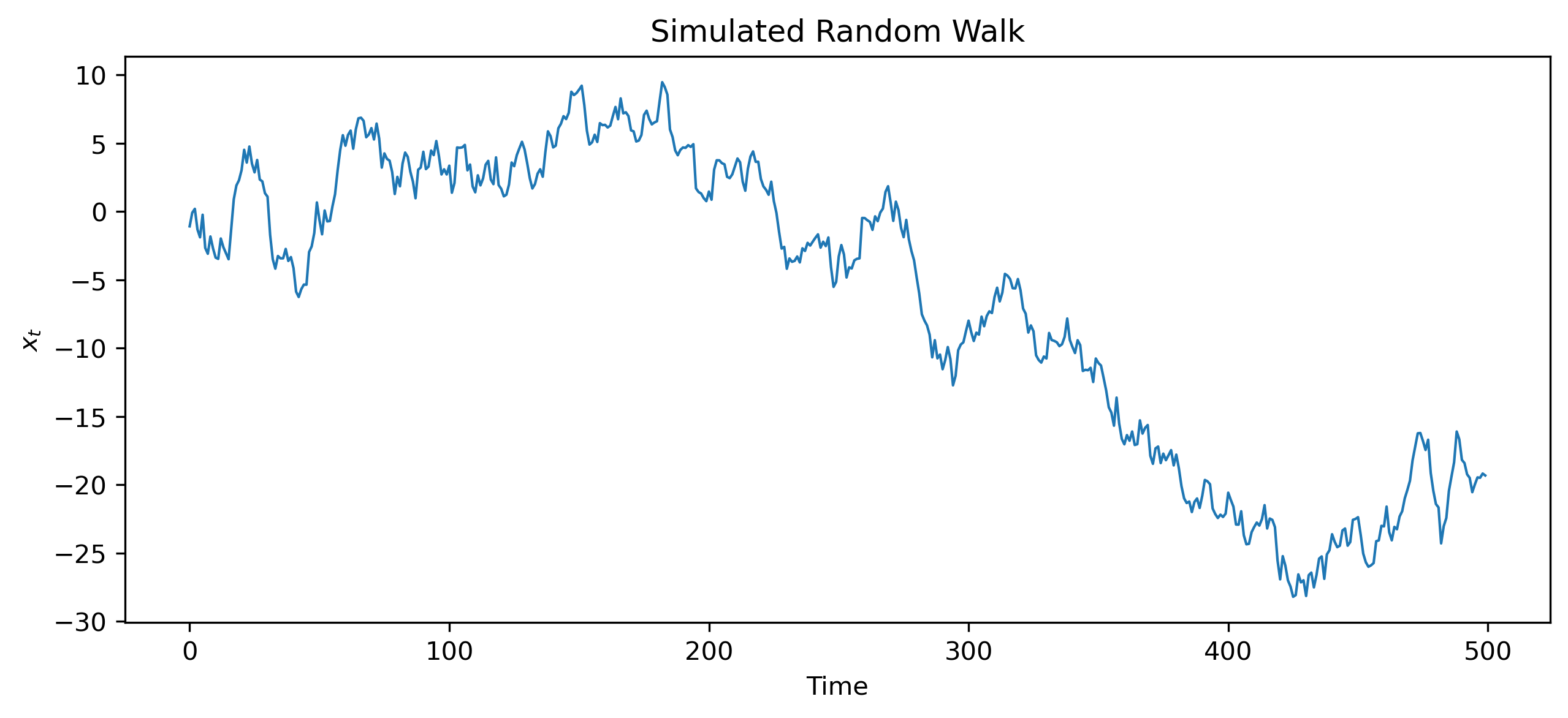
10.3 Why Random Walks Matter
Random walks are central in economics and finance.
Examples include:
stock prices
exchange rates
some macroeconomic aggregates
The random walk model implies:
strong persistence
unpredictable long-run movement
permanent effects of shocks
10.4 The Unit Root Idea
The random walk can be rewritten as:
with:
10.5 Why the Unit Root Matters
Consider:
Case 1: 
shocks gradually disappear
the series returns toward a stable mean
the process is stationary
Case 2: 
shocks never disappear
the series accumulates past shocks
the process becomes nonstationary
10.6 Stationary vs Unit Root Processes
Stationary Process
stable mean
stable variance
temporary shocks
Unit Root Process
drifting behavior
growing variance
permanent shocks
10.7 Simulating Different Levels of Persistence
Source
np.random.seed(123)

n = 500
w = np.random.normal(0,1,n)

x1 = np.zeros(n)
x2 = np.zeros(n)
x3 = np.zeros(n)

phi1 = 0.4
phi2 = 0.9
phi3 = 1.0

for t in range(1,n):
    x1[t] = phi1*x1[t-1] + w[t]
    x2[t] = phi2*x2[t-1] + w[t]
    x3[t] = phi3*x3[t-1] + w[t]

fig, ax = plt.subplots(3,1, figsize=(10,8))

ax[0].plot(x1)
ax[0].set_title(r"$\phi = 0.4$")

ax[1].plot(x2)
ax[1].set_title(r"$\phi = 0.9$")

ax[2].plot(x3)
ax[2].set_title(r"$\phi = 1.0$ (Unit Root)")

plt.tight_layout()

plt.savefig("figs/ch10/ar-sim.png", dpi=300, bbox_inches="tight")
plt.close()   # replace with plt.show()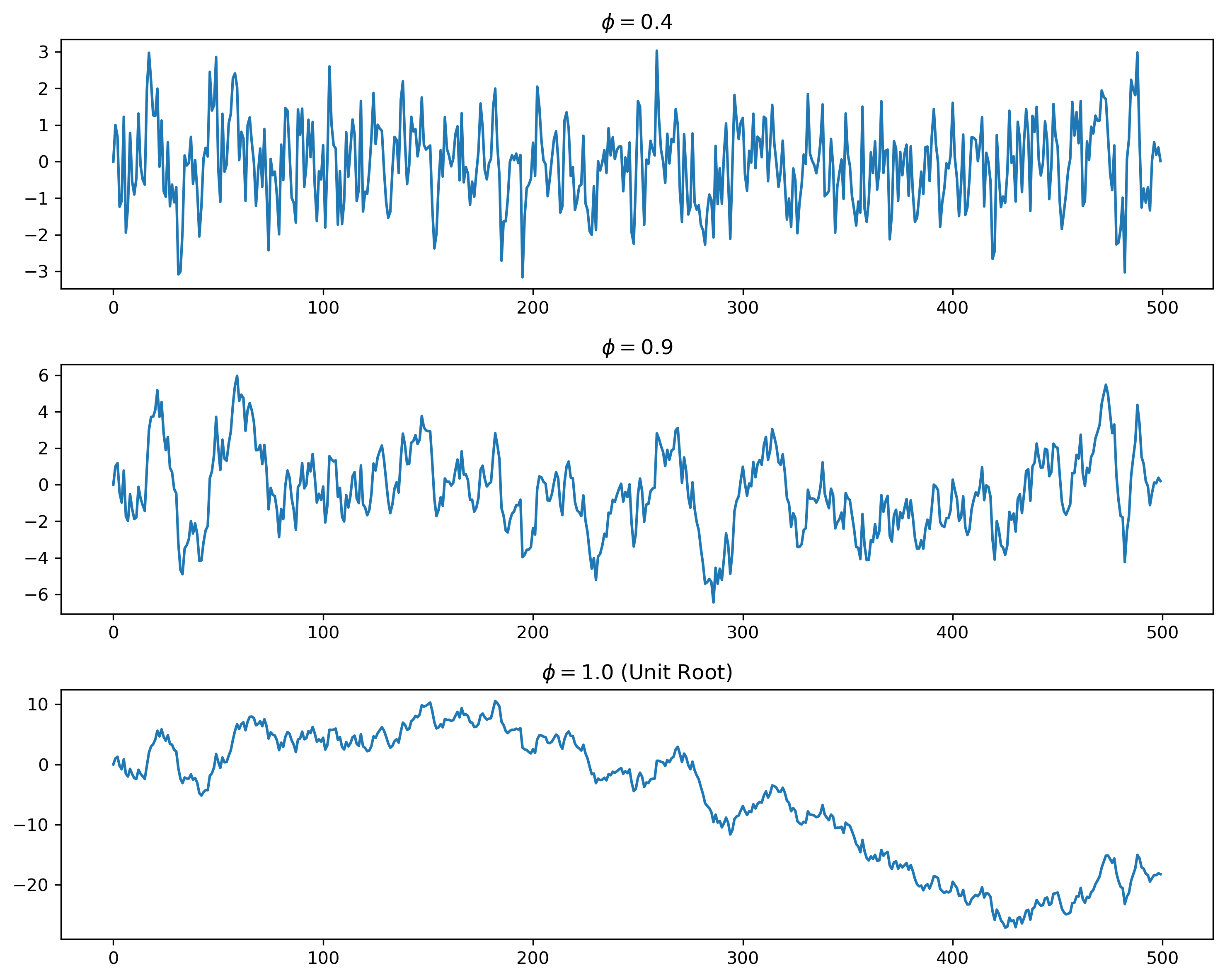
10.8 Differencing
A common way to remove unit roots is differencing.
10.9 Differencing a Random Walk
For a random walk:
Taking first differences:
10.10 Simulating Differencing
dx = np.diff(x)

plt.figure(figsize=(10,4))
plt.plot(dx, lw=1)
plt.title("First Difference of Random Walk")
plt.xlabel("Time")
plt.ylabel(r"$\Delta x_t$")

plt.savefig("figs/ch10/rw-diff.png", dpi=300, bbox_inches="tight")
plt.close()   # replace with plt.show()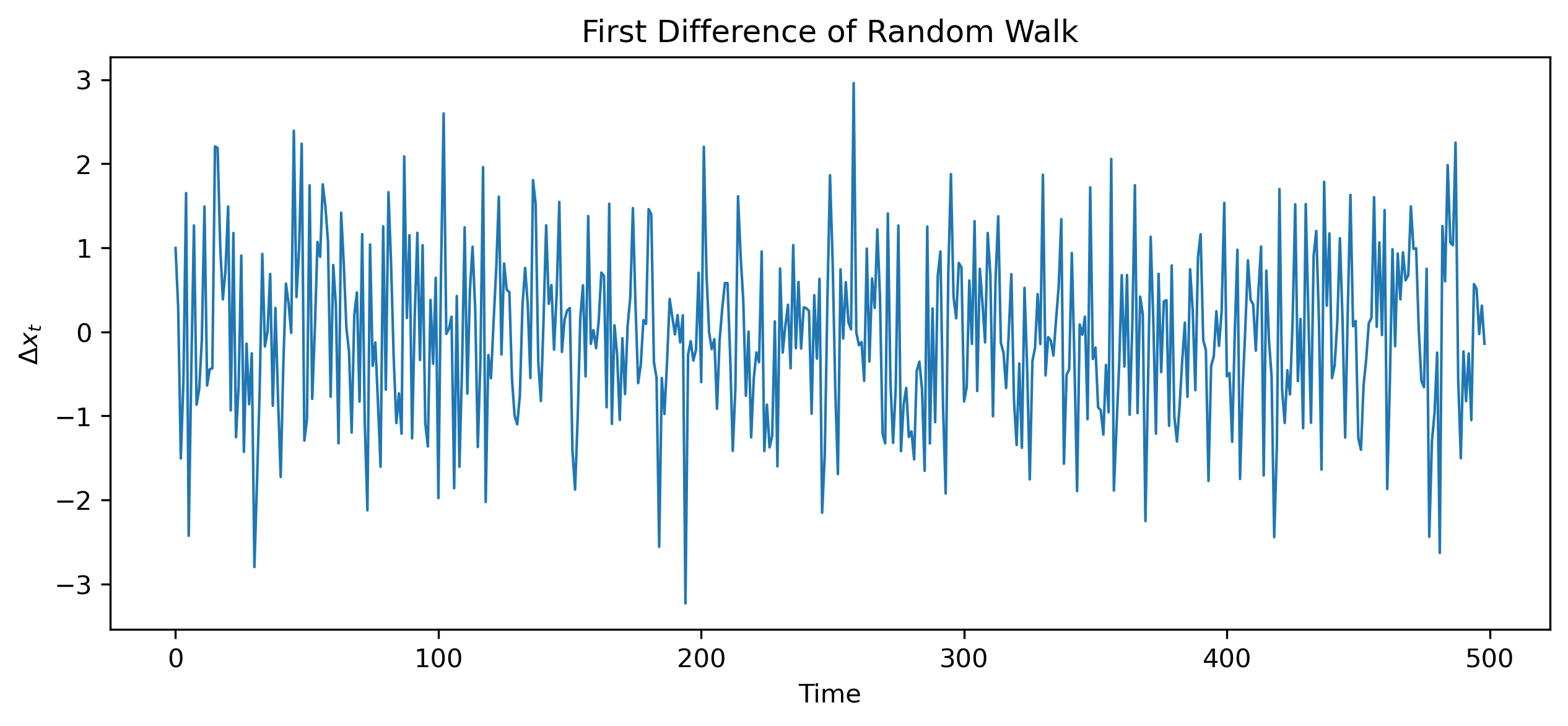
10.11 Integrated Processes
A unit root process is said to be integrated of order one.
Example
| Series | Order |
|---|---|
| White noise | |
| Random walk |
10.12 Detrending vs Differencing
Nonstationarity may arise for different reasons.
Deterministic Trend
Suppose:
where is stationary.
Removing the trend may produce stationarity.
Stochastic Trend
For a random walk:
detrending alone is insufficient.
Differencing is required.
10.13 Visual Comparison
Source
np.random.seed(123)

t = np.arange(500)

trend_stationary = 0.03*t + np.random.normal(0,1,500)

plt.figure(figsize=(10,4))
plt.plot(trend_stationary)
plt.title("Trend-Stationary Series")
plt.xlabel("Time")

plt.savefig("figs/ch10/trend.png", dpi=300, bbox_inches="tight")
plt.close()   # replace with plt.show()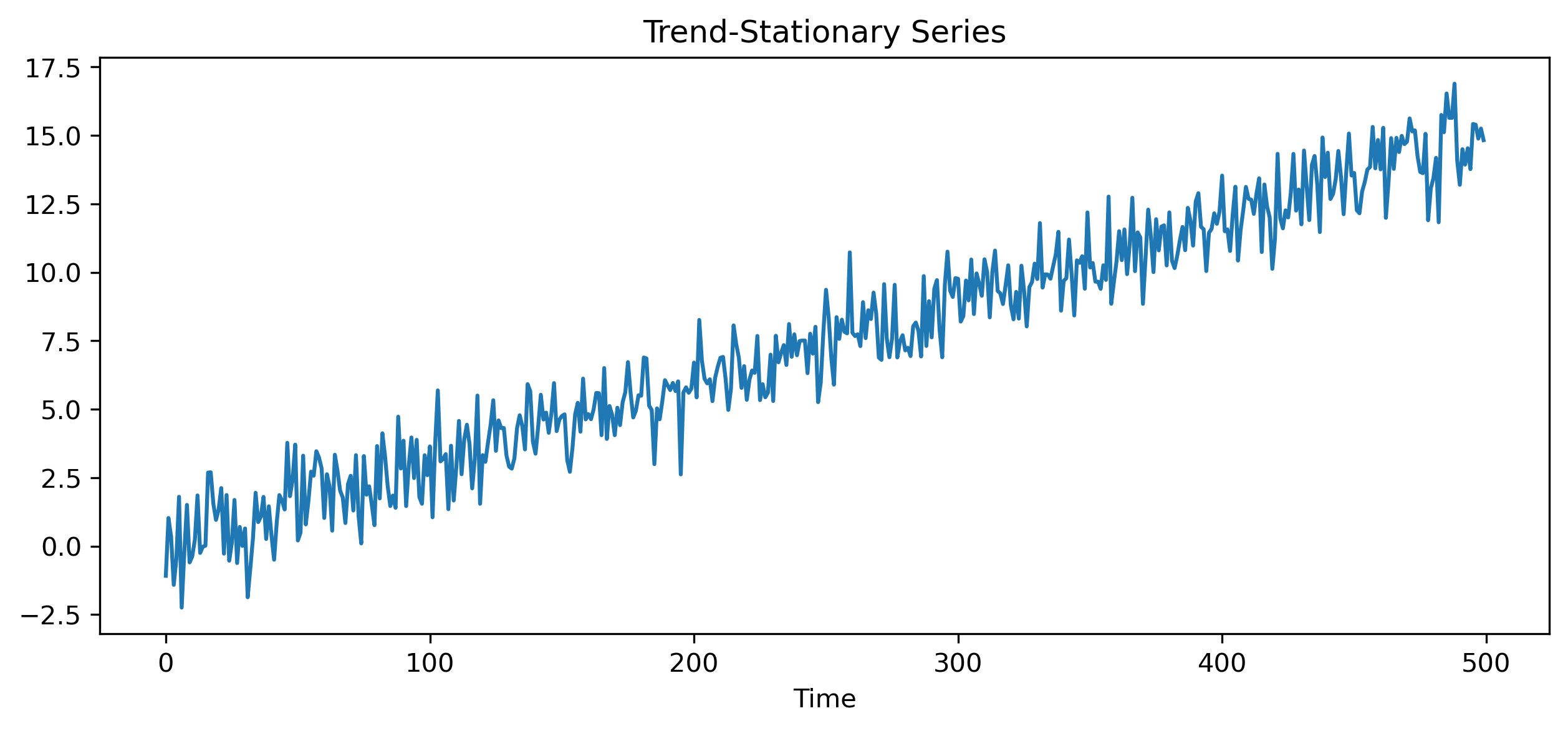
10.14 Why Unit Roots Matter
Unit roots affect:
forecasting
inference
regression
model selection
This problem becomes central later in:
spurious regression
cointegration
ECM models
10.15 The Dickey–Fuller Test
We now need a way to test for unit roots.
Consider:
Subtract from both sides:
or:
where:
Hypotheses
10.16 Augmented Dickey–Fuller (ADF) Test
Real-world data often exhibit serial correlation.
The Augmented Dickey–Fuller (ADF) test extends the Dickey–Fuller test by including lagged differences:
10.17 Interpreting the ADF Test
Reject 
evidence against a unit root
series likely stationary
Fail to Reject 
insufficient evidence against a unit root
series may be nonstationary
10.18 ADF Testing in Gretl
Menu
Variable → Unit root tests → Augmented Dickey-FullerTypical Steps
Choose variable
Include constant and/or trend if appropriate
Select lag length
Interpret test statistic and p-value
[GRETL Screenshot Placeholder: ADF test dialog][GRETL Screenshot Placeholder: ADF test output]10.19 KPSS Test (Optional)
The KPSS test reverses the hypotheses.
KPSS Hypotheses
10.20 Looking Ahead
In this chapter, we introduced:
unit roots
differencing
ADF testing
We are now ready to build formal stochastic models for stationary time series.
In the next chapters, we study:
autoregressive (AR) models
moving average (MA) models
ARMA and ARIMA models
Key Takeaways
Concept Check
Basic
What is a unit root?
What does it mean for a time series to be nonstationary?
What is a random walk?
Intuition
Why do shocks have permanent effects in a unit root process?
Why does a random walk not return to a stable level?
Why is nonstationarity problematic for modeling?
Intermediate
What is the purpose of differencing a time series?
What is the difference between:
a stationary process
a unit root process
What is the difference between:
deterministic trend
stochastic trend
Finance Insight
Why are stock prices often modeled as random walks?
Why are returns typically stationary?
Challenge
Suppose a series becomes stationary after differencing once.
What does this imply about the original series?
Interpretation & Practice
A time series shows a strong upward trend and does not return to a stable level.
What does this suggest?
What might be an appropriate transformation?
A series appears to “wander” over time.
What type of process might this be?
What does this imply about shocks?
After differencing, a series fluctuates around zero.
What does this suggest?
Why is this useful?
A regression between two trending series shows a strong relationship.
Why might this be misleading?
What concept does this illustrate?
A series has a deterministic upward trend.
Would differencing or detrending be more appropriate?
Why?
Finance Interpretation
A stock price series is nonstationary.
Why is modeling prices directly problematic?
Why are returns preferred?
A return series appears stable over time.
What does this suggest?
Why is this important?
Challenge
Suppose you difference a stationary series.
What might happen?
Why is over-differencing a problem?
Numerical Practice
Random Walk and Differencing
Suppose a random walk is defined as:
with:
shocks: 2, −1, 3, −2
Compute
Compute the first differences:
What do you observe?
What does this suggest?
Identifying Nonstationarity
Consider the series:
10, 12, 15, 19, 24
Does this appear stationary?
Compute the first differences
Does the differenced series look more stable?
Trend vs Difference
Suppose:
What type of trend is this?
Would differencing remove it?
What would the differenced series look like?
ADF Interpretation (Applied)
Consider the following output from an Augmented Dickey–Fuller (ADF) test:
Augmented Dickey-Fuller Test

Test Statistic:   -1.85
p-value:           0.67
Lags Used:         2
Observations:      197

Critical Values:
  1% level:       -3.46
  5% level:       -2.88
 10% level:       -2.57
What is the null hypothesis of the ADF test?
Compare the test statistic with the critical values.
Is the test statistic more negative than the 5% critical value?
Based on the p-value and test statistic:
Do you reject the null hypothesis?
What does this imply about the series?
What would you do next before modeling this series?
Second Example
Now consider:
Augmented Dickey-Fuller Test

Test Statistic:   -3.25
p-value:           0.02
Lags Used:         1
Observations:      198

Critical Values:
  1% level:       -3.46
  5% level:       -2.88
 10% level:       -2.57
Do you reject the null hypothesis at the 5% level?
What does this imply about stationarity?
Why might the test statistic be compared with critical values rather than relying only on the p-value?
Challenge
Suppose the test statistic is close to the critical value.
Why might conclusions be uncertain?
What additional checks could you perform?
Suppose you difference a series twice.
When might this be necessary?
What is the risk of doing this unnecessarily?
Suppose two nonstationary series are regressed on each other.
Why might the results be misleading?
What concept does this relate to?