Chapter 26 — GARCH Models
In the previous chapter, we introduced ARCH models for time-varying volatility.
ARCH models captured an important empirical feature of financial returns:
Large shocks are often followed by large shocks.
Small shocks are often followed by small shocks.
However, ARCH models sometimes require many lag terms to capture realistic volatility persistence.
GARCH models solve this problem by allowing volatility to depend not only on past shocks, but also on past volatility itself.
GARCH models became one of the most influential tools in financial econometrics.
They are widely used in:
risk management,
derivatives pricing,
portfolio analysis,
volatility forecasting,
and algorithmic trading.
Learning Objectives
By the end of this chapter, you should be able to:
explain the motivation for GARCH models
distinguish ARCH from GARCH
understand volatility persistence
estimate GARCH models
interpret GARCH coefficients
forecast volatility using GARCH
understand long-run variance
recognize common features of financial volatility
26.1 Why Move Beyond ARCH?
Recall the ARCH(1) model:
This model explains volatility using past squared shocks.
But real financial volatility often displays very persistent behavior.
A single lag may not be enough.
One solution is to add many ARCH lags:
However, this can become cumbersome.
26.2 The GARCH(1,1) Model
The most widely used specification is the GARCH(1,1) model.
Mean Equation
Suppose returns follow:
where:
is the mean return,
is the shock.
Variance Equation
The GARCH(1,1) variance equation is:
where:
= conditional variance,
= previous squared shock,
= previous conditional variance,
,
,
.
26.3 Interpreting the GARCH Equation
The GARCH model combines two forces:
ARCH Component
captures the impact of recent shocks.
Large shocks increase volatility.
GARCH Component
captures volatility persistence.
High volatility yesterday tends to imply high volatility today.
This is the defining idea behind GARCH models.
26.4 Volatility Persistence
One of the most important features of GARCH models is persistence.
Suppose markets experience a major financial shock.
Volatility often remains elevated for:
days,
weeks,
or even months.
GARCH models capture this gradual decay naturally.
26.5 The Persistence Parameter
A key quantity is:
Interpretation
| Value | Interpretation |
|---|---|
| small | volatility fades quickly |
| close to 1 | volatility is highly persistent |
In financial markets:
is often very close to 1.
26.6 Long-Run Variance
For a stable GARCH(1,1) process, the unconditional variance is:
provided:
26.7 Volatility Mean Reversion
GARCH models imply that volatility tends to revert toward a long-run level.
After periods of turbulence:
volatility gradually declines.
After unusually calm periods:
volatility gradually rises toward normal levels.
26.8 Simulating a GARCH Process
We now simulate a GARCH(1,1) process.
import numpy as np
import matplotlib.pyplot as plt

np.random.seed(123)

T = 1000

omega = 0.1
alpha = 0.1
beta = 0.85

e = np.zeros(T)
h = np.zeros(T)

z = np.random.normal(size=T)

h[0] = omega / (1 - alpha - beta)

for t in range(1, T):

    h[t] = (
        omega
        + alpha * e[t-1]**2
        + beta * h[t-1]
    )

    e[t] = np.sqrt(h[t]) * z[t]

plt.figure(figsize=(10,4))

plt.plot(e)

plt.title("Simulated GARCH(1,1) Process")

plt.savefig("figs/ch26/garch.png", dpi=300, bbox_inches="tight")
plt.close()   # replace with plt.show()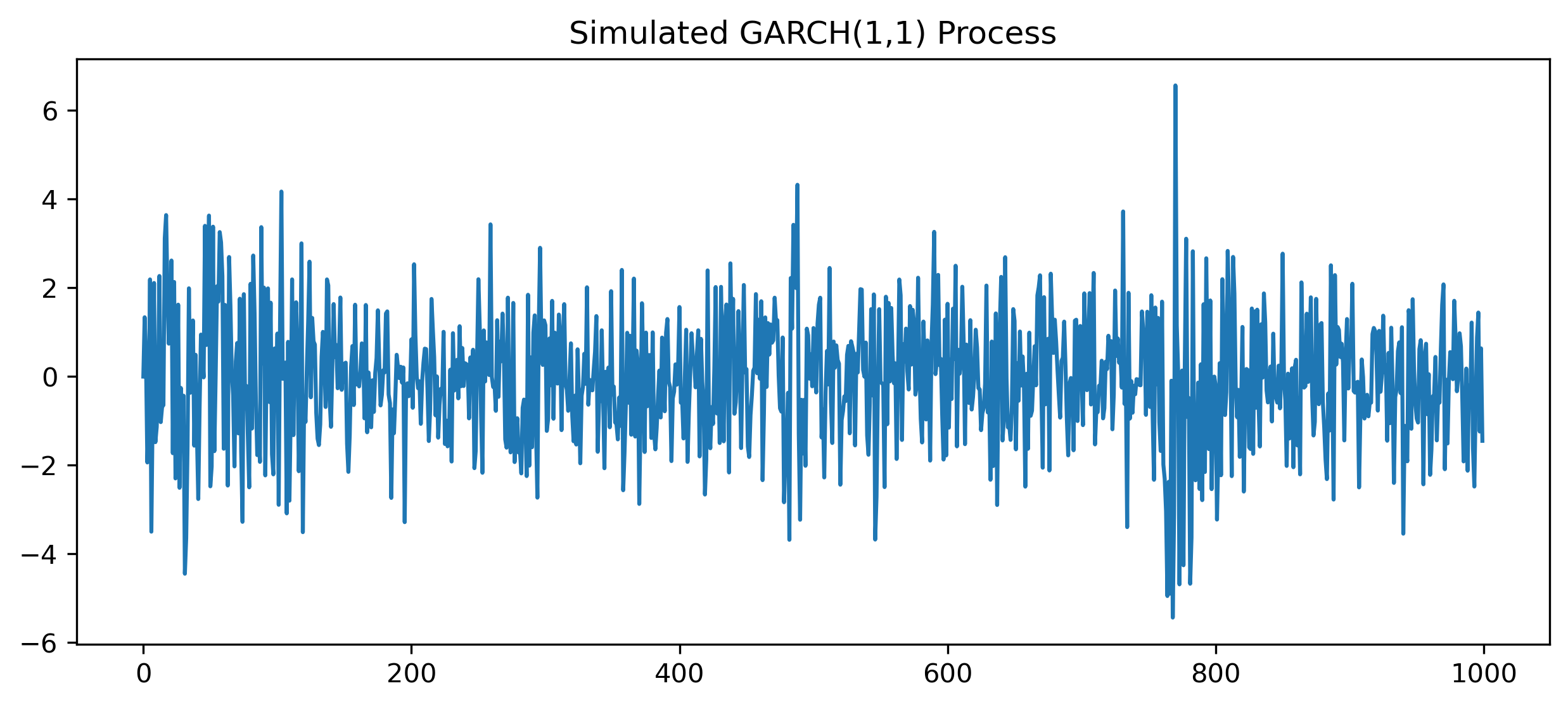
Volatility evolves gradually through time.
26.9 Comparing ARCH and GARCH
| Feature | ARCH | GARCH |
|---|---|---|
| uses past shocks | ✓ | ✓ |
| uses past variance | ✓ | |
| captures persistence efficiently | ✓ | |
| requires many lags | often | less often |
26.10 Estimating GARCH Models in Python
We now estimate a GARCH(1,1) model using real financial data.
import yfinance as yf
import numpy as np
from arch import arch_model

sp500 = yf.download("^GSPC", start="2018-01-01", auto_adjust=False)

returns = 100 * np.log(
    sp500["Adj Close"] /
    sp500["Adj Close"].shift(1)
).dropna()

model = arch_model(
    returns,
    vol="GARCH",
    p=1,
    q=1
)

results = model.fit()

print(results.summary())
[*********************100%***********************] 1 of 1 completed
Iteration: 1, Func. Count: 6, Neg. LLF: 13412183422872.883
Iteration: 2, Func. Count: 15, Neg. LLF: 1223492784.2470884
Iteration: 3, Func. Count: 22, Neg. LLF: 3665.895590631555
Iteration: 4, Func. Count: 28, Neg. LLF: 3592.664022773915
Iteration: 5, Func. Count: 35, Neg. LLF: 5965.318529783304
Iteration: 6, Func. Count: 41, Neg. LLF: 2895.7012213636317
Iteration: 7, Func. Count: 46, Neg. LLF: 2895.386785162664
Iteration: 8, Func. Count: 51, Neg. LLF: 2895.352625111166
Iteration: 9, Func. Count: 56, Neg. LLF: 2895.3516636015643
Iteration: 10, Func. Count: 61, Neg. LLF: 2895.351647138695
Iteration: 11, Func. Count: 66, Neg. LLF: 2895.351644993276
Iteration: 12, Func. Count: 70, Neg. LLF: 2895.3516449937133
Optimization terminated successfully (Exit mode 0)
Current function value: 2895.351644993276
Iterations: 12
Function evaluations: 70
Gradient evaluations: 12
Constant Mean - GARCH Model Results
==============================================================================
Dep. Variable: ^GSPC R-squared: 0.000
Mean Model: Constant Mean Adj. R-squared: 0.000
Vol Model: GARCH Log-Likelihood: -2895.35
Distribution: Normal AIC: 5798.70
Method: Maximum Likelihood BIC: 5821.28
No. Observations: 2091
Date: Thu, Apr 30 2026 Df Residuals: 2090
Time: 09:59:00 Df Model: 1
Mean Model
==========================================================================
coef std err t P>|t| 95.0% Conf. Int.
--------------------------------------------------------------------------
mu 0.0874 1.821e-02 4.799 1.592e-06 [5.170e-02, 0.123]
Volatility Model
============================================================================
coef std err t P>|t| 95.0% Conf. Int.
----------------------------------------------------------------------------
omega 0.0508 1.397e-02 3.634 2.785e-04 [2.340e-02,7.817e-02]
alpha[1] 0.1673 2.714e-02 6.164 7.079e-10 [ 0.114, 0.221]
beta[1] 0.7960 2.882e-02 27.621 6.164e-168 [ 0.740, 0.853]
============================================================================
Covariance estimator: robust26.11 Interpreting GARCH Output
Typical output includes estimates for:
| Parameter | Interpretation |
|---|---|
| baseline variance | |
| shock effect | |
| volatility persistence |
Example
Suppose estimates are:
| Parameter | Estimate |
|---|---|
| 0.051 | |
| 0.167 | |
| 0.796 |
Then:
which implies very persistent volatility.
26.12 Plotting Conditional Volatility
We now plot the estimated conditional volatility.
vol = results.conditional_volatility

vol.plot(figsize=(10,4))

plt.title("Estimated GARCH Volatility")

plt.savefig("figs/ch26/garch_vol.png", dpi=300, bbox_inches="tight")
plt.close()   # replace with plt.show()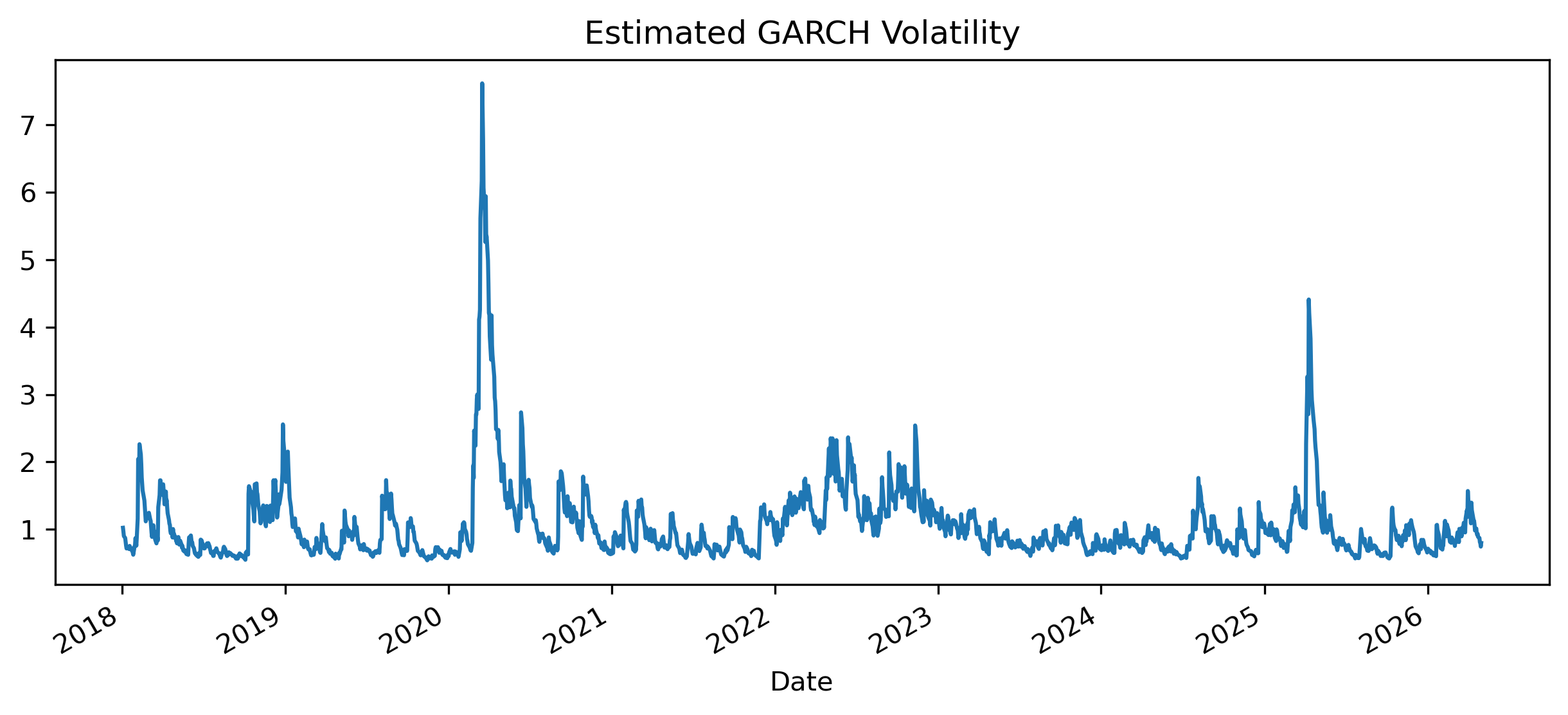
26.13 Volatility Forecasting
One of the main applications of GARCH models is volatility forecasting.
Examples include:
Value-at-Risk,
portfolio risk,
derivatives pricing,
stress testing.
26.14 Multi-Step Volatility Forecasts
GARCH models can produce forecasts for:
tomorrow’s volatility,
next week’s volatility,
future risk trajectories.
As the forecast horizon increases:
volatility forecasts gradually converge toward long-run variance.
26.15 GARCH and Financial Crises
During crises:
shocks become large,
volatility spikes sharply,
persistence increases.
Examples include:
the 2008 Global Financial Crisis,
the COVID-19 market collapse,
cryptocurrency crashes.
Example from Financial Markets
[Figure Placeholder: GARCH volatility during financial crisis]26.16 Fat Tails and GARCH
Even if the underlying shocks are normal, GARCH processes often generate:
volatility clustering,
excess kurtosis,
fat tails.
This happens because volatility itself changes through time.
26.17 Limitations of Standard GARCH
Standard GARCH models are powerful but imperfect.
They may struggle to capture:
asymmetric volatility,
leverage effects,
sudden structural breaks,
extreme market crashes.
Example: Leverage Effect
Negative stock market shocks often increase volatility more than positive shocks.
This motivates extensions such as:
EGARCH,
TGARCH,
GJR-GARCH.
26.18 Gretl Example: Estimating GARCH
Gretl provides straightforward tools for GARCH estimation.
Step 1 — Open Data
Load a financial return series.
Step 2 — Estimate GARCH
Menu:
Model → Time Series → GARCHStep 3 — Choose Orders
For a standard GARCH(1,1):
ARCH order = 1
GARCH order = 1
[GRETL Screenshot Placeholder: GARCH estimation dialog]Interpreting Gretl Output
Typical output includes:
coefficient estimates,
standard errors,
persistence measures,
log-likelihood values.
to ensure variance stability.
26.19 Common Mistakes
26.20 Looking Ahead
GARCH models provide a powerful framework for modeling financial volatility.
However, financial volatility often displays asymmetry and nonlinear behavior.
More advanced models extend the GARCH framework further.
Key Takeaways
Concept Check
Basic
What is a GARCH model?
How does GARCH differ from ARCH?
What does the variance equation represent?
Intuition
What does it mean to say “volatility has memory”?
Why do financial markets exhibit persistent volatility?
Why is it unrealistic to assume constant variance?
Structure
In the GARCH(1,1) model:
what does represent?
what does represent?
Why are both components needed?
Persistence
What does the quantity measure?
What does it mean if is close to 1?
Long-Run Behavior
What is the long-run variance?
Why does volatility revert toward a long-run level?
Challenge
Can volatility be highly persistent even if shocks are short-lived?
Interpretation & Practice
A GARCH model estimates:
What does this imply about persistence?
A large shock occurs in the market.
What does the GARCH model predict for future volatility?
Volatility declines slowly after a crisis.
What does this suggest about ?
is large but is small.
What does this imply?
is large but is small.
What does this imply?
Mean Reversion
Why does volatility eventually return to a long-run level?
Economic Interpretation
Why is volatility persistence important for risk management?
Challenge
Why might a GARCH model produce fat tails even with normal shocks?
Why might negative returns increase volatility more than positive returns? What real-world behavior does this reflect?
Numerical Practice
GARCH Equation
Suppose:
and:
Compute .
Persistence
Compute:
What does this imply?
Long-Run Variance
Suppose:
Compute long-run variance:
Interpretation
If :
what does this imply?
Stability
What happens if:
Forecasting
Why do volatility forecasts converge to long-run variance?
Challenge
Suppose volatility is very persistent.
What does this imply about risk forecasting?
You estimate a GARCH(1,1) model for stock returns and find:
Is volatility persistent?
How quickly does it decay?
What does this imply for risk management?
Graph Interpretation
Consider a GARCH volatility plot showing:
large spikes during crises
slow decline afterward
What does this suggest about volatility persistence?
Why does volatility not drop immediately?
What does this imply about ?
Comparison
Compare two series:
one where volatility drops quickly
one where volatility persists
Which has higher ?
Challenge
Why is volatility easier to observe than to predict precisely?
Appendix 26A — Stability Condition for GARCH(1,1)
For the GARCH(1,1) model:
the stability condition is:
Why This Matters
If:
then volatility shocks may never decay fully.
Variance may become nonstationary or explosive.
is to 1, the more persistent volatility becomes.
Appendix 26B — ARCH vs GARCH Intuition
ARCH models say:
Volatility depends on recent shocks.GARCH models add:
Volatility also depends on past volatility itself.This additional persistence greatly improves empirical realism.
Appendix 26C — Extensions of GARCH Models
Standard GARCH models assume that positive and negative shocks have the same effect on volatility.
In financial markets, this is often unrealistic.
This phenomenon is known as the leverage effect.
C.1 Why Extensions Are Needed
Empirical evidence shows:
stock market declines → sharp increase in volatility
stock market increases → smaller effect
Standard GARCH cannot capture this asymmetry.
C.2 GJR-GARCH Model
The GJR-GARCH model introduces asymmetry:
where:
is an indicator for negative shocks
C.3 EGARCH Model
The EGARCH model uses a logarithmic specification:
C.4 T-GARCH (Threshold GARCH)
T-GARCH models also capture asymmetric responses:
volatility behaves differently depending on shock size or sign
C.5 Key Takeaways
C.6 Practical Insight
C.7 When to Use Extensions
Consider extensions when:
markets show strong crash behavior
negative shocks dominate volatility
risk management is critical
C.8 Looking Ahead
Advanced volatility models are widely used in:
option pricing
portfolio risk
stress testing
Understanding asymmetry is essential for realistic financial modeling.