Chapter 7 — Randomness and Dependence
In earlier chapters, we explored financial returns, smoothing methods, and trading indicators. We now begin developing the core ideas of time series analysis more formally.
A central insight of time series analysis is that observations collected over time are often dependent. What happens today may be related to what happened yesterday, last week, or even many periods ago.
This chapter introduces:
stochastic processes
white noise
dependence across time
persistence
random walks
These ideas form the conceptual foundation for later chapters on stationarity, ARIMA models, forecasting, and cointegration.
Learning Objectives
By the end of this chapter, you should be able to:
explain what a time series is
distinguish randomness from dependence
understand white noise processes
interpret persistence in economic and financial data
understand the random walk model
simulate and visualize simple stochastic processes
7.1 What Is a Time Series?
Examples include:
daily stock prices
quarterly GDP
monthly inflation
exchange rates
unemployment rates
rainfall measurements
A time series can be written as:
where:
indexes time
is the observation at time
For example:
inflation this month is related to inflation last month
stock prices today are related to yesterday’s prices
GDP evolves gradually over time
7.2 Stochastic Processes
A time series is usually viewed as a realization of a stochastic process.
We observe only one realization of the process:
but we imagine that these observations are generated by an underlying probabilistic mechanism.
7.3 Randomness and Dependence
In statistics, we often study random variables independently. In time series analysis, however, the timing of observations matters.
Two key questions arise:
How random is the process?
How dependent are observations over time?
Example: Daily Stock Returns
Daily returns appear highly random:
difficult to predict exactly
fluctuate around zero
heavily influenced by news and expectations
But even highly random processes may still exhibit:
persistence
volatility clustering
serial dependence
7.4 White Noise
The simplest stochastic process is white noise.
Thus:
mean is constant
variance is constant
observations are uncorrelated over time
We often write:
7.5 Simulating White Noise
import numpy as np
import matplotlib.pyplot as plt

np.random.seed(10101)

wn = np.random.normal(0, 2, 500)

plt.figure(figsize=(10,4))
plt.plot(wn, lw=1)
plt.title("Simulated White Noise")
plt.xlabel("Time")
plt.ylabel("$w_t$")

plt.savefig("figs/ch7/wn.png", dpi=300, bbox_inches="tight")
plt.close()   # replace with plt.show()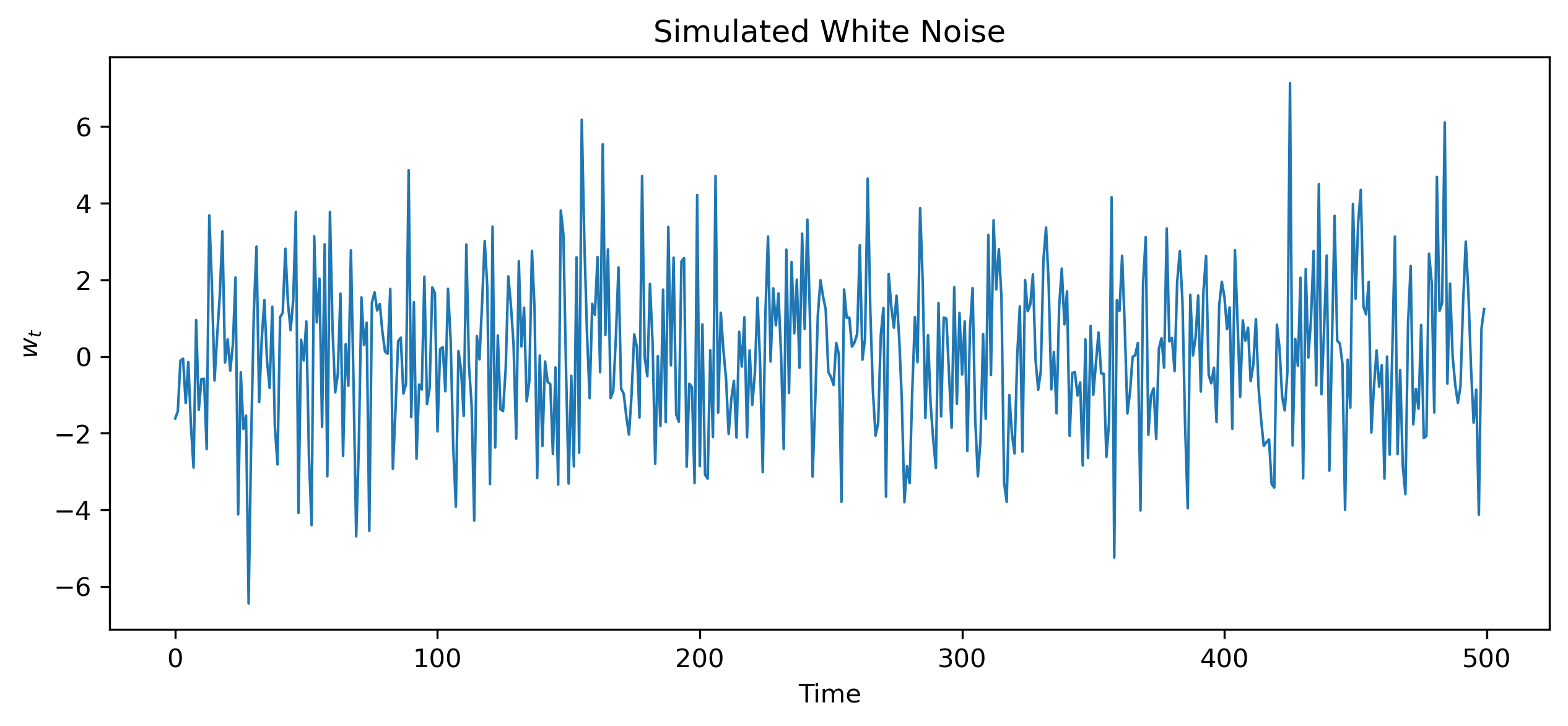
7.6 Gaussian White Noise
If white noise is normally distributed, we call it Gaussian white noise.
Gaussian white noise is widely used in theoretical models because it is mathematically convenient.
7.7 Covariance and Correlation
To study dependence across time, we first review covariance and correlation.
Variance
Covariance
Correlation
7.8 Dependence Across Time
In time series analysis, we are interested in relationships such as:
and more generally:
where is called the lag.
7.9 Persistence
Some time series exhibit strong persistence.
Examples:
inflation
interest rates
exchange rates
stock prices
In persistent series:
shocks may have long-lasting effects
observations change gradually over time
7.10 Random Walks
One of the most important models in time series analysis is the random walk.
Interpretation
Each new observation equals:
the previous value
plus a random shock
7.11 Simulating a Random Walk
np.random.seed(123)

w = np.random.normal(0, 1, 500)
x = np.cumsum(w)

plt.figure(figsize=(10,4))
plt.plot(x, lw=1)
plt.title("Simulated Random Walk")
plt.xlabel("Time")
plt.ylabel("$x_t$")

plt.savefig("figs/ch7/rw.png", dpi=300, bbox_inches="tight")
plt.close()   # replace with plt.show()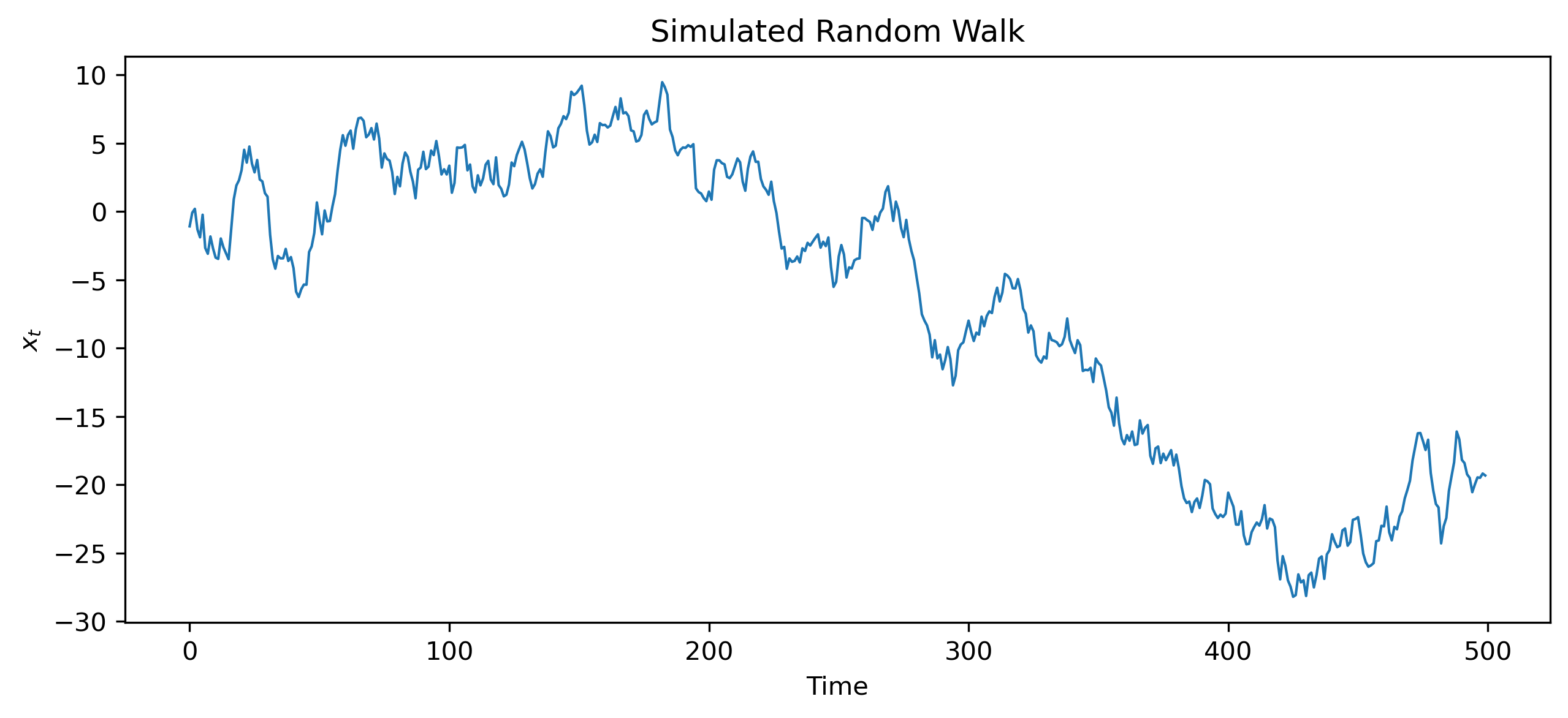
7.12 White Noise vs Random Walk
| Feature | White Noise | Random Walk |
|---|---|---|
| Mean reverting | Yes | No |
| Persistent | No | Yes |
| Variance constant | Yes | No |
| Predictable structure | None | Strong persistence |
7.13 Why Random Walks Matter
Random walks play a central role in economics and finance.
Examples include:
stock prices
exchange rates
some macroeconomic aggregates
Financial Interpretation
If stock prices follow a random walk:
past price movements contain little forecasting power
price changes are difficult to predict systematically
This idea is closely related to the efficient market hypothesis.
7.14 Looking Ahead
In this chapter, we introduced:
stochastic processes
white noise
dependence
persistence
random walks
These ideas naturally lead to the concept of stationarity, which we study in the next chapter.
Key Takeaways
Concept Check
Basic
What is a stochastic process?
What is white noise?
What is a random walk?
Intuition
Why are observations in a time series typically not independent?
What does it mean for a series to exhibit persistence?
Why is white noise considered unpredictable?
Intermediate
What is serial dependence?
What is a lag in time series analysis?
Why can a random walk look like it has a trend even if it does not?
Finance Insight
Why might stock prices behave like a random walk?
What does this imply about the ability to predict future prices?
Challenge
Suppose a series looks smooth and trending.
Does this imply it is predictable?
Why or why not?
Interpretation & Practice
Consider a white noise series.
What pattern would you expect to see in a plot?
Why is it difficult to forecast?
Consider a random walk.
Why does it appear to drift over time?
What role do past shocks play?
A series shows strong persistence.
What does this imply about the effect of shocks?
How might this affect forecasting?
A plot shows large swings but no clear pattern.
Is this more likely white noise or a random walk?
Why?
A time series appears to trend upward.
What are two possible explanations?
Why must we be careful in interpreting this?
Behavioral Insight
A trader believes that an upward trend will continue.
What assumption are they making about dependence?
Why might this be misleading?
Challenge
Suppose you simulate two series:
Series A: white noise
Series B: random walk
Which one is easier to predict?
Why?
Numerical Practice
White Noise vs Random Walk
Suppose you observe the following values:
Series A:
2, −1, 1, −2, 0, 1Series B:
2, 1, 2, 0, 0, 1Which series looks more like white noise?
Which looks more persistent?
Step-by-Step Random Walk
Suppose a random walk is defined as:
[ x_t = x_{t-1} + w_t ]
with:
initial value (x_0 = 100)
shocks (w_t): 2, −1, 3, −2
Compute (x_1, x_2, x_3, x_4)
What do you notice about how shocks affect the series?
Variance Intuition
Consider two processes:
white noise
random walk
Which one has constant variance over time?
Which one becomes more volatile as time increases?
Why?
Persistence
Suppose a shock of +5 occurs in:
a white noise process
a random walk
How long does the effect last in each case?
Challenge
Suppose you observe a series that behaves like a random walk.
Why might differencing the series remove persistence?
What do you expect the differenced series to look like?