Chapter 23 — Impulse Response Functions
In the previous chapter, we introduced VAR models as systems of interacting time series.
VAR models allow:
multiple variables,
dynamic feedback,
and recursive interactions
to be modeled jointly.
But VAR coefficient tables are often difficult to interpret directly.
Suppose we estimate a VAR involving:
stock returns,
volatility,
interest rates,
or inflation.
A natural question immediately arises:
Impulse response functions (IRFs) were developed precisely to answer such questions.
IRFs trace:
how shocks propagate,
how long effects persist,
and how systems gradually adjust through time.
This chapter introduces:
dynamic shock propagation,
impulse response functions,
orthogonalization,
identification,
confidence intervals,
and forecast error variance decomposition (FEVD).
The emphasis remains intuition-first and applications-oriented.
Learning Objectives
By the end of this chapter, you should be able to:
explain the intuition behind impulse response functions
interpret dynamic responses to shocks
distinguish contemporaneous and lagged effects
understand orthogonalized shocks
interpret confidence bands
generate IRFs in Python and GRETL
understand identification issues in VAR analysis
interpret IRFs economically
23.1 Why Impulse Responses Matter
Economic systems are dynamic.
A shock today may influence variables:
immediately,
gradually,
or persistently.
For example:
a monetary tightening may reduce inflation only slowly,
an oil-price shock may affect output for many quarters,
a financial crisis may generate persistent volatility.
23.2 What Is an Impulse Response Function?
The response is tracked period by period.
Example
Suppose interest rates suddenly increase unexpectedly.
We may ask:
How does inflation respond?
How long do effects persist?
Do effects eventually disappear?
IRFs attempt to answer these questions visually and dynamically.
23.3 Why VAR Coefficients Are Difficult to Interpret
In univariate models, coefficients are often interpreted directly.
VAR systems are different.
Because variables interact dynamically:
effects propagate across variables,
responses accumulate through time,
and feedback loops emerge.
A shock today may influence:
tomorrow,
next week,
or many future periods.
This is why IRFs became one of the central tools of modern macroeconomics and finance.
23.4 Intuition: Dropping a Stone into Water
A useful analogy is:
Dropping a stone into water.The initial splash creates waves.
The waves then:
spread,
interact,
and gradually disappear.
Economic shocks behave similarly.
23.5 Impulse Responses in a VAR
Consider a VAR involving:
inflation,
interest rate.
Suppose an unexpected interest-rate shock occurs today.
The VAR traces:
inflation tomorrow,
inflation next month,
inflation next year,
and so on.
Dynamic Feedback
Because variables interact:
inflation affects interest rates,
interest rates affect inflation,
and responses feed back through time.
This creates rich dynamic behavior.
Example
Suppose central banks unexpectedly raise interest rates.
Possible dynamic effects include:
| Period | Possible Effect |
|---|---|
| immediate | borrowing becomes more expensive |
| short run | investment falls |
| medium run | output slows |
| longer run | inflation declines |
23.6 Reading Impulse Response Functions
Impulse response functions contain several types of economic information.
When reading an IRF, economists often focus on:
direction,
timing,
persistence,
and stability.
Direction
Does the response move:
upward,
downward,
or change sign through time?
Timing
Does the response occur:
immediately,
gradually,
or with delay?
Persistence
Do effects disappear quickly?
Or do they remain for many periods?
Stability
Does the response eventually return toward zero?
Oscillation
Some responses:
overshoot,
fluctuate,
and oscillate before stabilizing.
This often reflects rich dynamic feedback within the system.
Positive and Negative Responses
Impulse responses may be:
positive,
negative,
or mixed over time.
For example:
a monetary tightening may reduce inflation,
an oil-price shock may initially raise inflation,
stock markets may react positively or negatively depending on expectations.
23.7 Common Shapes of Impulse Responses
Impulse responses may display several common dynamic patterns.
Understanding these patterns helps economists interpret dynamic systems more effectively.
Rapidly Decaying Response
Some shocks disappear quickly.
This suggests:
weak persistence,
fast adjustment,
and strong system stability.
Source
import numpy as np
import matplotlib.pyplot as plt

h = np.arange(15)

irf = np.exp(-0.8*h)

plt.figure(figsize=(7,4))

plt.plot(h, irf, marker="o")

plt.axhline(0, linestyle="--", linewidth=1)

plt.title("Rapidly Decaying Impulse Response")
plt.xlabel("Horizon")
plt.ylabel("Response")

plt.tight_layout()

plt.savefig("figs/ch23/rapid_decay.png",
            dpi=300,
            bbox_inches="tight")

plt.close()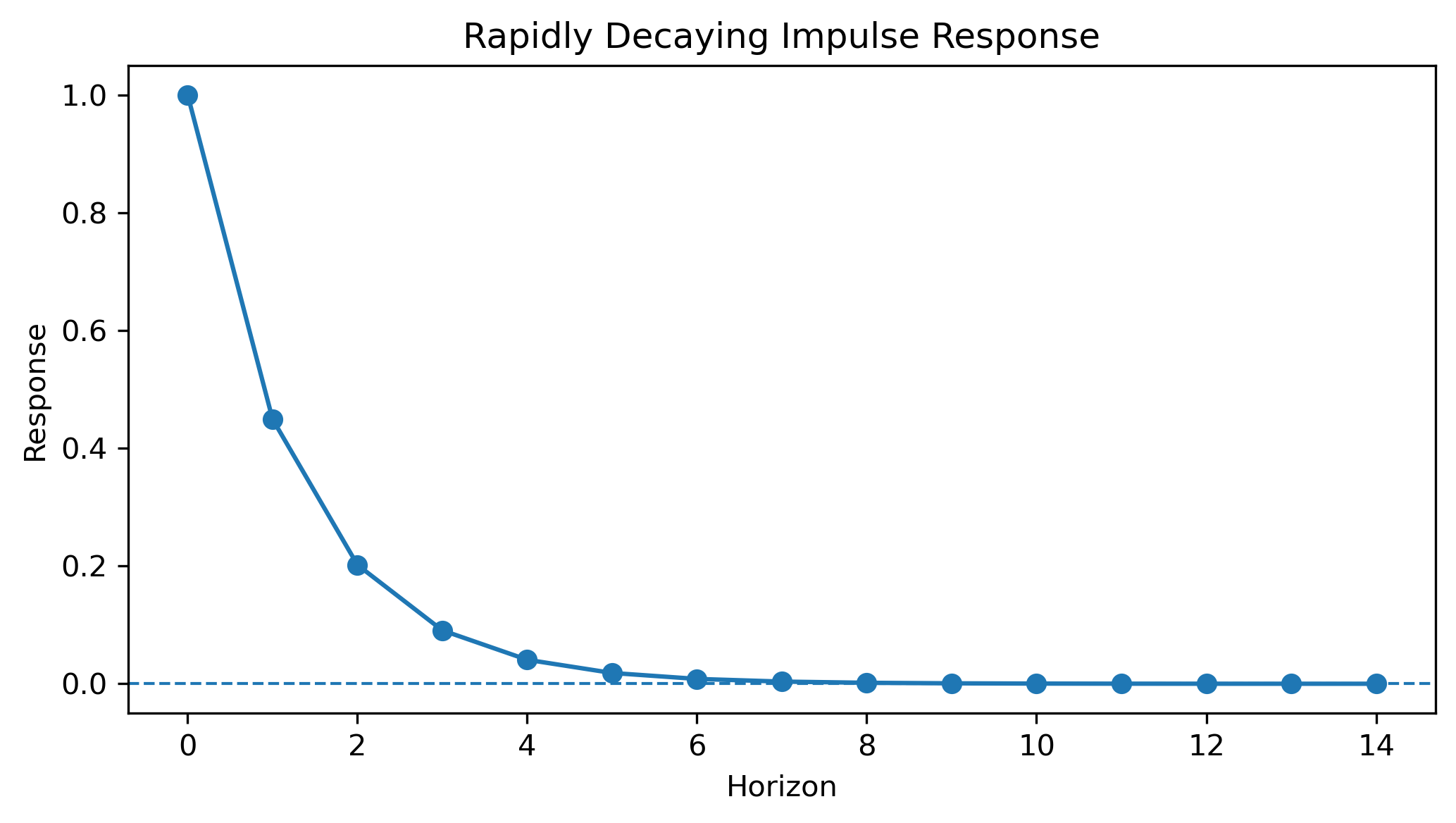
Persistent Response
Some shocks decay only gradually.
This suggests:
strong persistence,
long memory,
or slow adjustment dynamics.
Source
h = np.arange(20)

irf = 0.95**h

plt.figure(figsize=(7,4))

plt.plot(h, irf, marker="o")

plt.axhline(0, linestyle="--", linewidth=1)

plt.title("Persistent Impulse Response")
plt.xlabel("Horizon")
plt.ylabel("Response")

plt.tight_layout()

plt.savefig("figs/ch23/persistent_irf.png",
            dpi=300,
            bbox_inches="tight")

plt.close()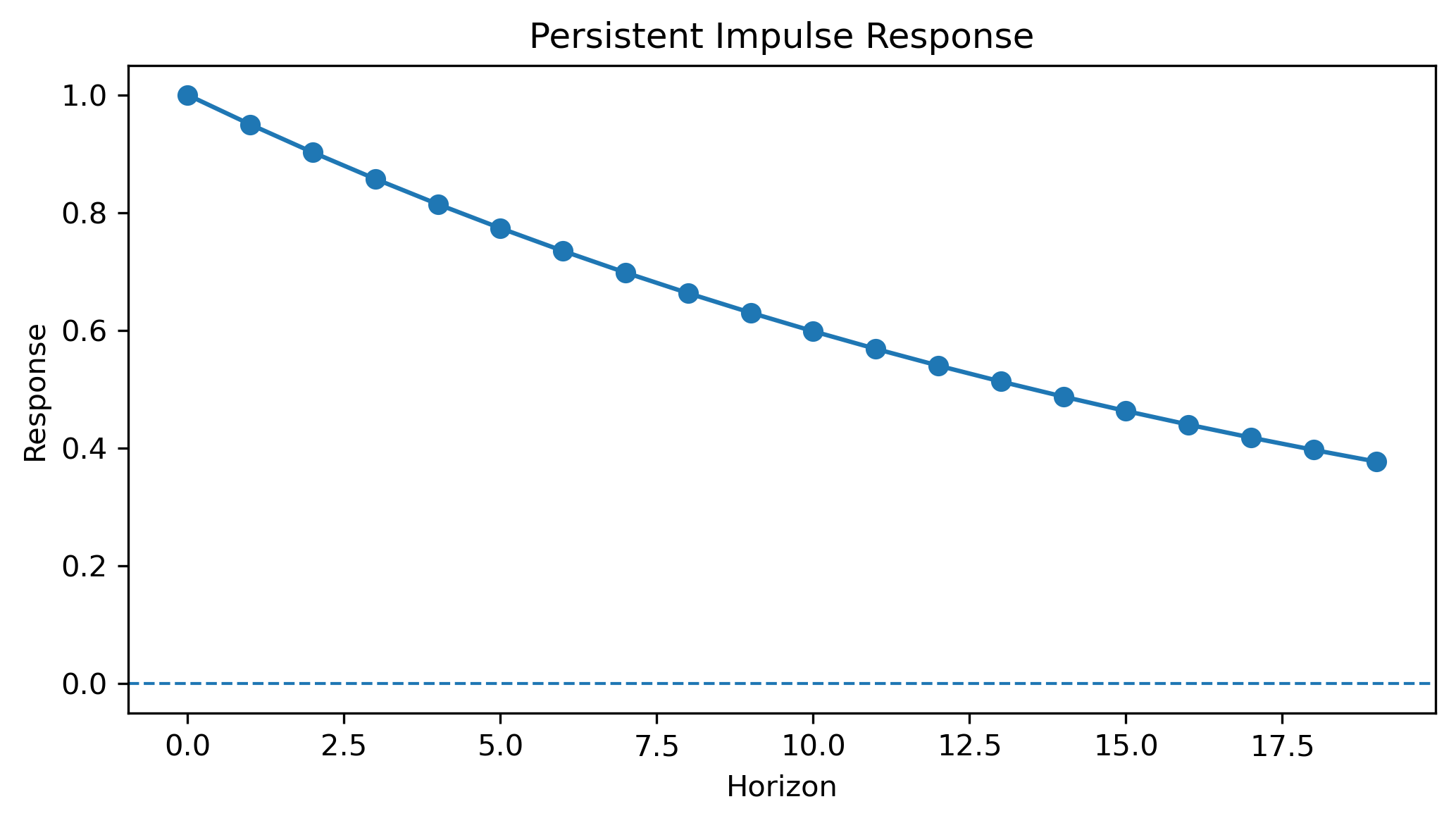
Oscillating Response
Some systems overshoot and oscillate before stabilizing.
This may reflect:
delayed adjustment,
cyclical dynamics,
or strong feedback effects.
Source
h = np.arange(20)

irf = np.exp(-0.15*h) * np.cos(1.2*h)

plt.figure(figsize=(7,4))

plt.plot(h, irf, marker="o")

plt.axhline(0, linestyle="--", linewidth=1)

plt.title("Oscillating Impulse Response")
plt.xlabel("Horizon")
plt.ylabel("Response")

plt.tight_layout()

plt.savefig("figs/ch23/oscillating_irf.png",
            dpi=300,
            bbox_inches="tight")

plt.close()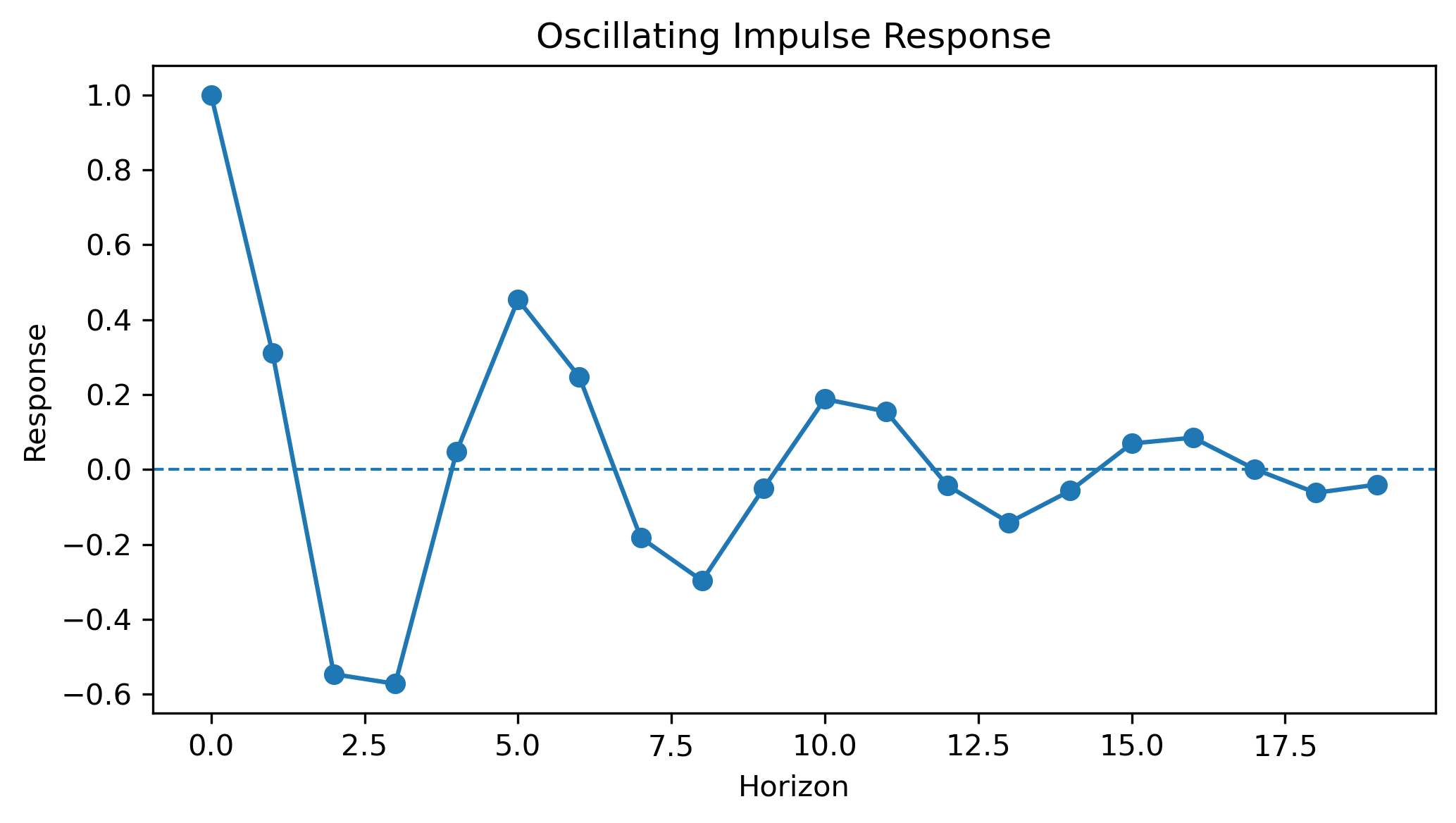
Explosive Response
An unstable system may produce impulse responses that grow through time.
This suggests:
instability,
explosive dynamics,
or misspecification.
Source
h = np.arange(12)

irf = 1.15**h

plt.figure(figsize=(7,4))

plt.plot(h, irf, marker="o")

plt.axhline(0, linestyle="--", linewidth=1)

plt.title("Explosive Impulse Response")
plt.xlabel("Horizon")
plt.ylabel("Response")

plt.tight_layout()

plt.savefig("figs/ch23/explosive_irf.png",
            dpi=300,
            bbox_inches="tight")

plt.close()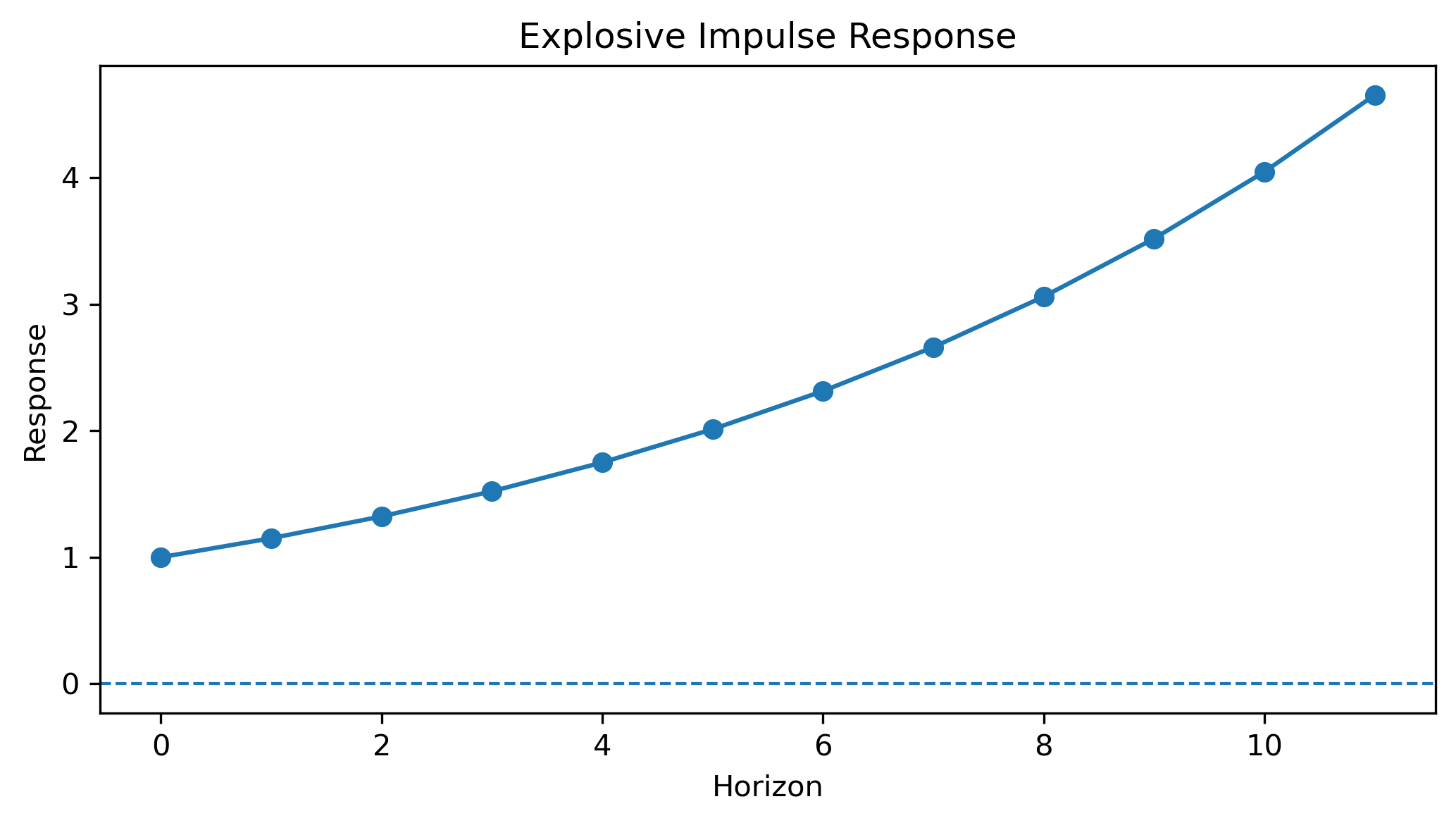
23.8 Why Orthogonalization Is Necessary
A major complication arises because VAR shocks are often correlated.
For example:
stock-market shocks,
volatility shocks,
and interest-rate shocks
may occur simultaneously.
This creates an important problem.
This is the motivation for orthogonalization.
23.9 Cholesky Decomposition
One common solution is:
Cholesky decompositionThis transforms correlated shocks into orthogonal shocks.
Intuition
Suppose stock returns and volatility both move unexpectedly today.
Cholesky decomposition attempts to separate:
the pure return shock,
from the pure volatility shock.
This allows impulse responses to trace cleaner dynamic effects.
23.10 Ordering and Identification
Orthogonalized impulse responses depend on variable ordering.
Example ordering:
returns
volatility
interest rate
This ordering implicitly imposes assumptions about contemporaneous relationships.
For example:
returns may affect volatility immediately,
but volatility may affect returns only with delay.
Why Ordering Matters
Different orderings may produce:
different impulse responses,
different persistence patterns,
and different economic conclusions.
This is one reason IRFs should be interpreted carefully.
23.11 Structural Interpretation
Reduced-form VARs describe:
dynamic dependence,
correlations,
and propagation patterns.
But economists are often interested in structural interpretation.
For example:
What is a monetary policy shock?Answering this requires economic theory and identifying assumptions.
Structural interpretation requires assumptions about the economic system.
Structural interpretation requires assumptions.
23.12 Confidence Intervals and Uncertainty
Impulse responses are estimated statistically.
Therefore they contain uncertainty.
Confidence intervals help assess statistical precision.
Interpretation
Wide confidence bands imply:
substantial uncertainty,
lower precision,
and weaker statistical confidence.
Responses close to zero may not be economically meaningful.
23.13 Estimating IRFs in Python
We now estimate impulse responses using a financial VAR system.
The system contains:
SPY daily log returns,
and a rolling volatility proxy.
This example is useful because:
financial shocks often propagate dynamically,
volatility is highly persistent,
and responses are visually intuitive.
import yfinance as yf
import pandas as pd
import numpy as np
import matplotlib.pyplot as plt

from statsmodels.tsa.api import VAR

# Download data
spy = yf.download(
    "SPY",
    start="2015-01-01",
    auto_adjust=False
)

# Compute returns
returns = 100 * np.log(
    spy["Adj Close"] /
    spy["Adj Close"].shift(1)
)

returns = returns.dropna()

# Volatility proxy
volatility = returns.rolling(20).std()

# Combine variables
data = pd.concat(
    [returns, volatility],
    axis=1
)

data.columns = [
    "Returns",
    "Volatility"
]

data = data.dropna()

# Estimate VAR
model = VAR(data)

results = model.fit(2)

# Impulse responses
irf = results.irf(12)

fig, axes = plt.subplots(
    2,2,
    figsize=(10,8),
    facecolor="white"
    )

# plt.style.use("default")
irf.plot()

plt.savefig("figs/ch23/irf.png", dpi=300, bbox_inches="tight")
plt.close()   # replace with plt.show()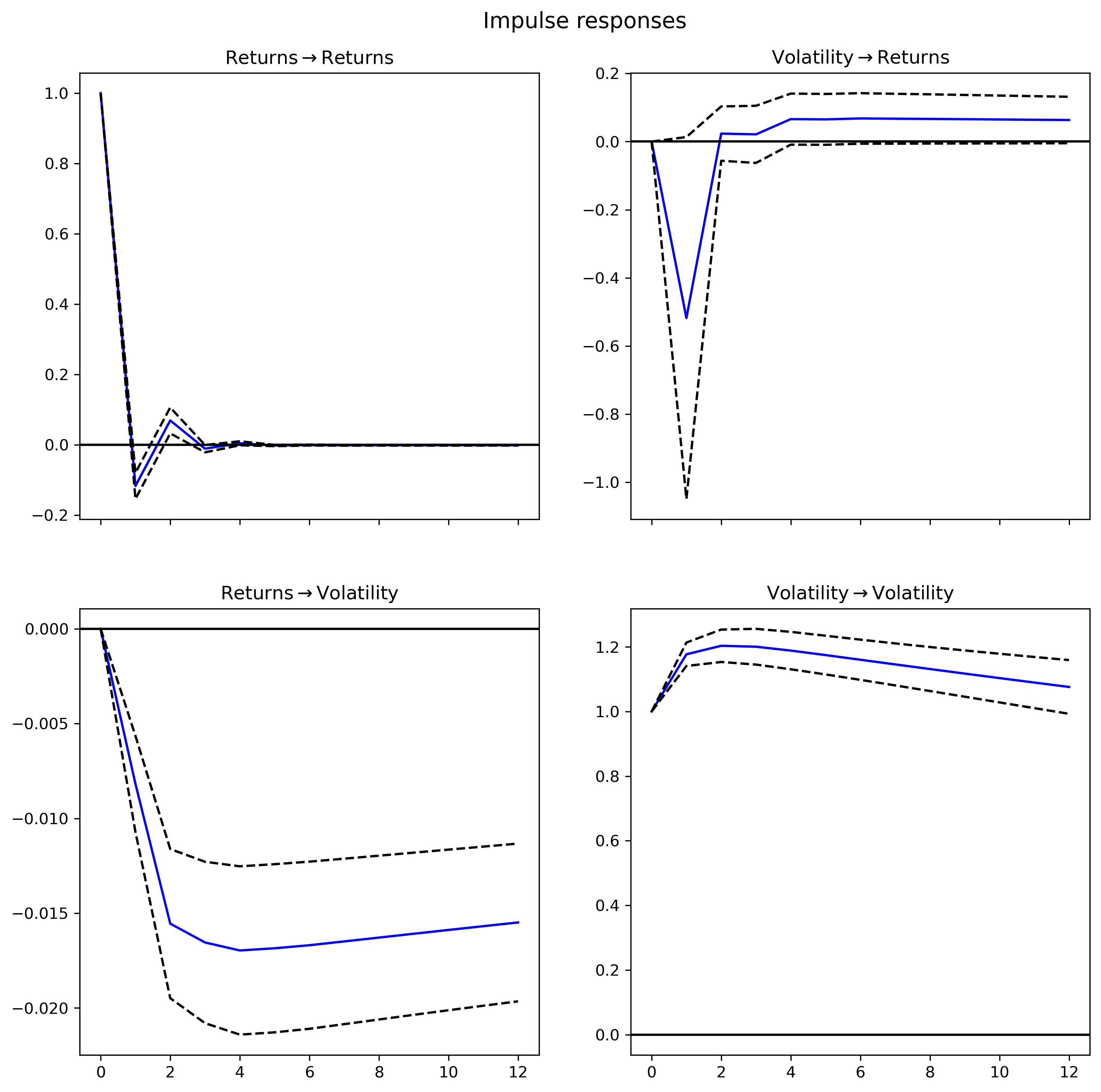
23.14 Interpreting the IRF Results
Figure above shows impulse responses for the VAR system containing:
stock returns,
and volatility.
Several important dynamic patterns emerge.
Returns Shock → Returns
The response of returns to their own shock decays very quickly.
This suggests:
weak persistence in returns,
rapid adjustment,
and relatively short-lived shocks.
Volatility Shock → Volatility
Volatility responses are much more persistent.
The effects decay only gradually through time.
This is one reason volatility modeling becomes especially important in finance.
Cross-Variable Responses
The off-diagonal impulse responses show how shocks propagate across variables.
For example:
return shocks influence future volatility,
volatility shocks influence future returns.
This illustrates the dynamic feedback captured by VAR systems.
Confidence Bands
The dashed lines represent confidence intervals.
Wide confidence bands imply:
greater uncertainty,
and less statistical precision.
Responses close to zero may not be economically meaningful.
General Interpretation
Impulse responses help answer questions such as:
How large are shock effects?
How long do effects persist?
Do shocks disappear quickly or slowly?
Are responses economically plausible?
23.15 Forecast Error Variance Decomposition (FEVD)
Impulse responses show how shocks propagate dynamically.
Another important question is:
Forecast Error Variance Decomposition (FEVD) helps answer this question.
FEVD measures how much forecast uncertainty comes from different shocks.
Intuition
Suppose volatility forecasts are highly uncertain.
FEVD asks:
how much uncertainty comes from volatility shocks?
how much comes from return shocks?
which shocks dominate over time?
23.16 Interpreting FEVD Results
Impulse responses are especially useful because they connect:
data,
dynamics,
and economic theory.
Examples include:
monetary transmission,
fiscal policy effects,
exchange-rate dynamics,
financial contagion.
FEVD tables summarize the relative importance of different shocks.
For example:
volatility shocks may dominate short-run volatility forecasts,
while return shocks may become more important over longer horizons.
23.17 Impulse Responses and Economic Theory
Suppose central banks unexpectedly raise interest rates.
Possible impulse responses:
| Variable | Possible Response |
|---|---|
| inflation | declines gradually |
| GDP | slows |
| unemployment | rises |
| exchange rate | appreciates |
Delayed Effects
Many macroeconomic responses occur only after several periods.
This is sometimes called:
policy transmission lag23.18 Impulse Responses in Finance
IRFs are also widely used in finance.
Examples include:
volatility spillovers,
stock market contagion,
oil-price shocks,
exchange-rate transmission.
Example
Question:
How does a U.S. market shock affect Asian stock markets?VAR and IRF methods are commonly used to study such problems.
23.19 IRFs and Stability
In stable systems:
impulse responses eventually converge toward zero.
In unstable systems:
responses may explode.
23.20 Generalized Impulse Responses
Standard orthogonalized IRFs depend on ordering assumptions.
An alternative approach is Generalized Impulse Responses
Generalized IRFs reduce sensitivity to variable ordering.
Trade-Off
Orthogonalized IRFs:
are easier to interpret structurally,
but depend heavily on ordering.
Generalized IRFs:
reduce ordering sensitivity,
but may be harder to interpret economically.
Different identification approaches may produce different impulse responses.
23.21 Gretl Example: Impulse Responses
Gretl provides built-in tools for IRF analysis.
Step 1
Estimate a VAR model.
Menu:
Model → Time Series → VARStep 2
From the VAR output window:
Analysis → Impulse responsesStep 3
Choose:
shock variable,
response variable,
forecast horizon,
confidence intervals.
[GRETL Screenshot Placeholder: IRF settings]23.22 Reading IRF Graphs
Typical IRF graphs show:
horizontal axis = time horizon,
vertical axis = response magnitude.
The zero line is especially important.
23.23 Common Mistakes
23.24 Looking Ahead
Impulse responses allow us to move from:
toward:
The next chapter introduces Vector Error Correction Models (VECMs), which combine:
short-run dynamics,
long-run equilibrium,
and multivariate adjustment mechanisms
within a unified framework.
We will move from
temporary dynamic interactions
toward:
long-run equilibrium systems.
Key Takeaways
Concept Check
Basic
What is an impulse response function (IRF)?
What does a “shock” represent in a VAR model?
Why are IRFs used instead of directly interpreting VAR coefficients?
Intuition
Explain the “stone in water” analogy for impulse responses.
Why do economic shocks often have effects over multiple periods?
What does it mean for a shock to “propagate” through a system?
Dynamics
What is the difference between:
contemporaneous effects
lagged effects
Why do impulse responses often decay over time?
Challenge
What does it mean if an impulse response does not decay?
Interpretation & Practice
An IRF shows:
a positive initial response
gradual decay to zero
What does this imply?
An IRF shows a negative response after a positive shock.
What does this suggest about the relationship?
An IRF oscillates before stabilizing.
What might this indicate?
An IRF is close to zero at all horizons.
What does this imply?
Persistence
A shock has effects that persist for many periods.
What does this suggest about the system?
A shock disappears quickly.
What does this imply?
Confidence Bands
Confidence intervals are wide.
What does this imply?
Confidence bands include zero.
What does this suggest?
Challenge
Why should IRFs always be interpreted together with confidence intervals?
Orthogonalization & Identification
Why are VAR shocks often correlated?
What is orthogonalization?
What does Cholesky decomposition do?
Ordering
Why does variable ordering matter?
What assumption is made when a variable is ordered first?
What assumption is made when a variable is ordered last?
Interpretation
Why are IRFs not automatically causal?
Challenge
How can different ordering assumptions change conclusions?
Numerical & Graph Interpretation
Interpreting an Impulse Response Function
Consider the following impulse response function:
Source
import numpy as np
import matplotlib.pyplot as plt

horizon = np.arange(10)

# stylized IRF: rise → peak → decay
irf = [0.0, 0.5, 0.9, 1.2, 1.0, 0.7, 0.4, 0.2, 0.1, 0.0]

plt.figure(figsize=(8,4))
plt.plot(horizon, irf, marker='o')

plt.axhline(0, linestyle='--', linewidth=1)

plt.title("Stylized Impulse Response Function")
plt.xlabel("Horizon")
plt.ylabel("Response")

plt.tight_layout()

plt.savefig("figs/ch23/irf_Q.png", dpi=300, bbox_inches="tight")
plt.close()   # replace with plt.show()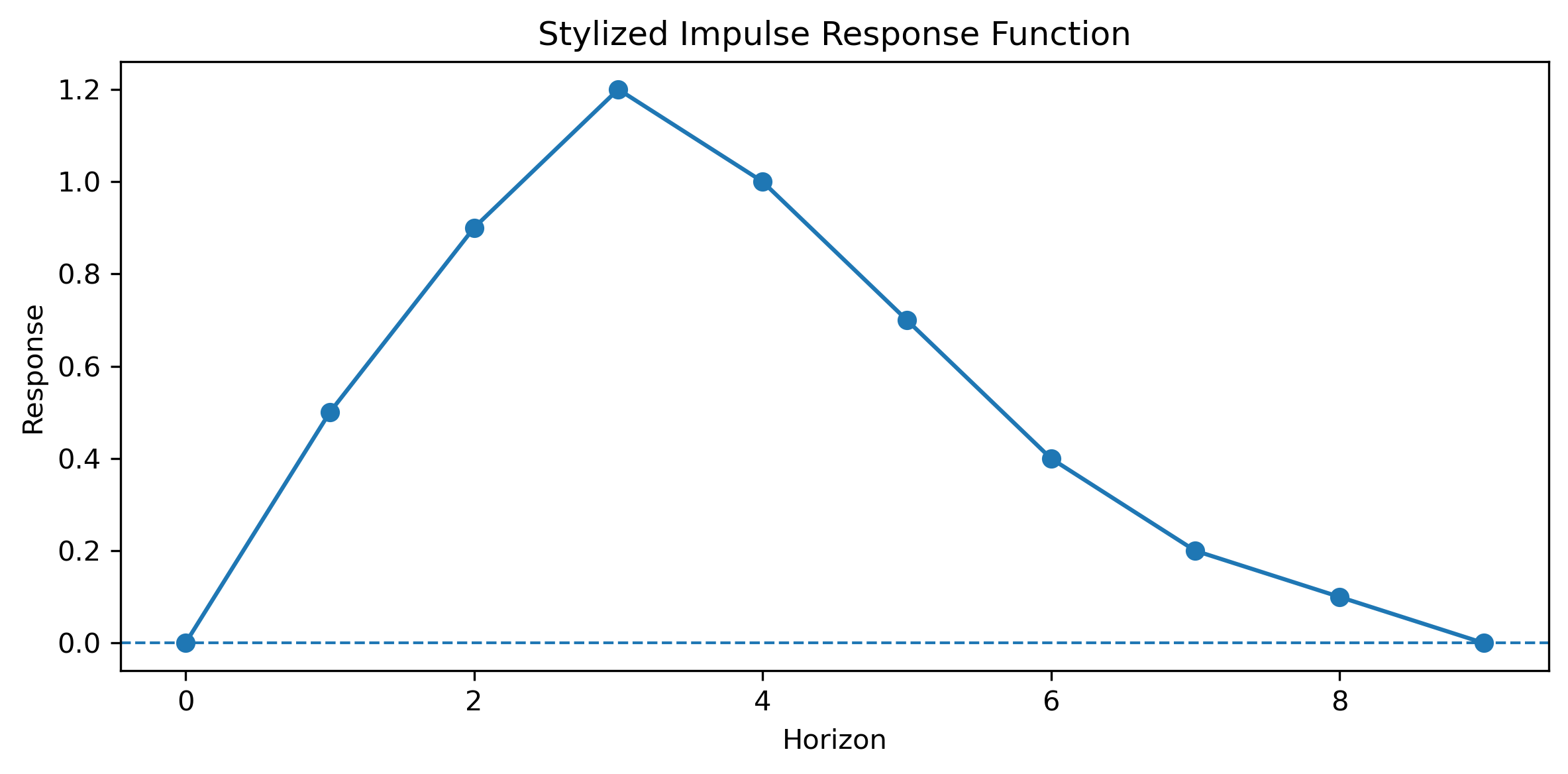
Describe the pattern of the impulse response.
At what period does the response peak?
Does the effect persist or disappear quickly?
What does this suggest about the dynamic impact of the shock?
Reading an IRF
Suppose an IRF shows:
initial increase
peak after 3 periods
slow decline
What does this suggest?
Cumulative Effects
Why might we use cumulative impulse responses?
Suppose cumulative IRF increases steadily.
What does this imply?
Stability
Suppose IRFs grow larger over time.
What does this imply?
Comparison
Two IRFs:
one decays quickly
one decays slowly
Which system is more persistent?
Challenge
Suppose a shock produces different responses depending on ordering.
What does this suggest?
Appendix 23A — Orthogonalized vs Generalized IRFs
Orthogonalized IRFs:
rely on Cholesky decomposition,
depend on variable ordering.
Generalized IRFs:
reduce ordering sensitivity,
but may be harder to interpret structurally.
Different approaches may produce somewhat different results.
Appendix 23B — Why Impulse Responses Became Popular
VAR coefficient matrices are often difficult to interpret directly.
Impulse responses became popular because they:
summarize complex dynamics visually,
describe propagation mechanisms,
connect statistical models with economic narratives.
They transformed VAR analysis from:
large coefficient tablesinto dynamic economic interpretation.