Chapter 8 — Stationarity
In the previous chapter, we introduced stochastic processes, white noise, persistence, and random walks.
We now turn to one of the most important concepts in time series analysis:
This idea is captured by the concept of stationarity.
Stationarity plays a central role in:
forecasting
statistical inference
ARIMA modeling
autocorrelation analysis
regression with time series data
Learning Objectives
By the end of this chapter, you should be able to:
explain what stationarity means
distinguish strict and weak stationarity
understand why stationarity matters
identify nonstationary behavior visually
distinguish white noise from random walks
understand the role of mean, variance, and autocovariance
8.1 Why Does Stationarity Matter?
Suppose we use historical data to forecast the future.
This only makes sense if the underlying probabilistic structure remains reasonably stable over time.
Examples
A stationary series might exhibit:
stable fluctuations around a constant mean
roughly constant variability
dependence patterns that remain stable
A nonstationary series might exhibit:
trending behavior
changing variance
structural shifts
persistent drift
8.2 Strict Stationarity
We begin with the most general definition.
More formally:
for all:
time points
shifts
sample sizes
Example
If we look at:
their joint distributions should be identical under strict stationarity.
8.3 Weak Stationarity
In practice, strict stationarity is often stronger than necessary.
Most time series methods instead rely on weak stationarity.
8.4 Mean and Variance Stability
A stationary process has stable first and second moments.
Constant Mean
does not depend on time.
Constant Variance
does not change over time.
Stable Covariance Structure
The covariance:
depends only on lag .
8.5 White Noise Revisited
Recall white noise from Chapter 7.
White noise satisfies:
constant mean
constant variance
zero covariance across time
Thus white noise is stationary.
Simulating White Noise
Source
import numpy as np
import matplotlib.pyplot as plt

np.random.seed(10101)

wn = np.random.normal(0, 2, 500)

plt.figure(figsize=(10,4))
plt.plot(wn, lw=1)
plt.title("Simulated White Noise")
plt.xlabel("Time")
plt.ylabel("$w_t$")

# plt.savefig("figs/ch8/wn.png", dpi=300, bbox_inches="tight")
plt.close()   # replace with plt.show()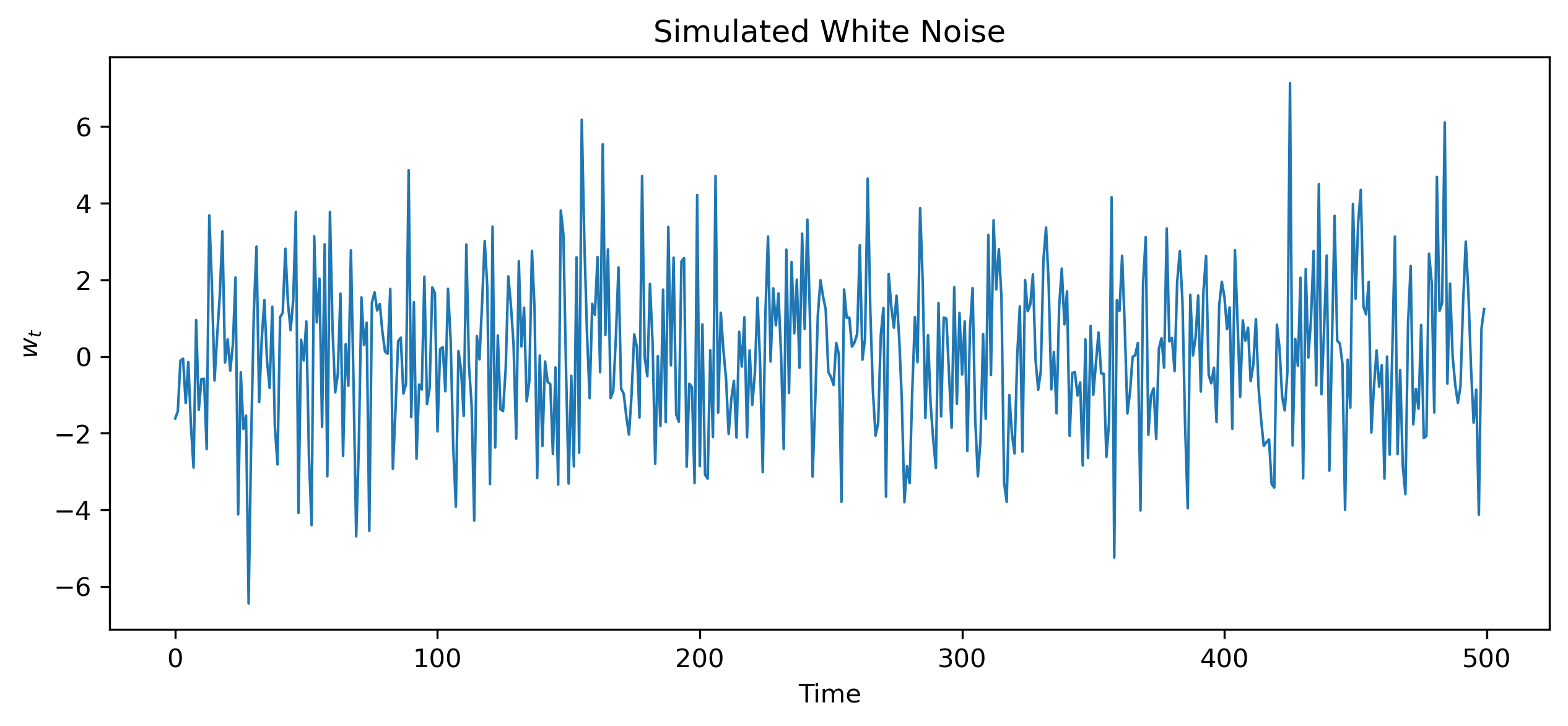
8.7 Random Walks Revisited
Now consider the random walk:
where is white noise.
Simulating a Random Walk
Source
np.random.seed(123)

w = np.random.normal(0, 1, 500)
x = np.cumsum(w)

plt.figure(figsize=(10,4))
plt.plot(x, lw=1)
plt.title("Simulated Random Walk")
plt.xlabel("Time")
plt.ylabel("$x_t$")

# plt.savefig("figs/ch7/rw.png", dpi=300, bbox_inches="tight")
plt.close()   # replace with plt.show()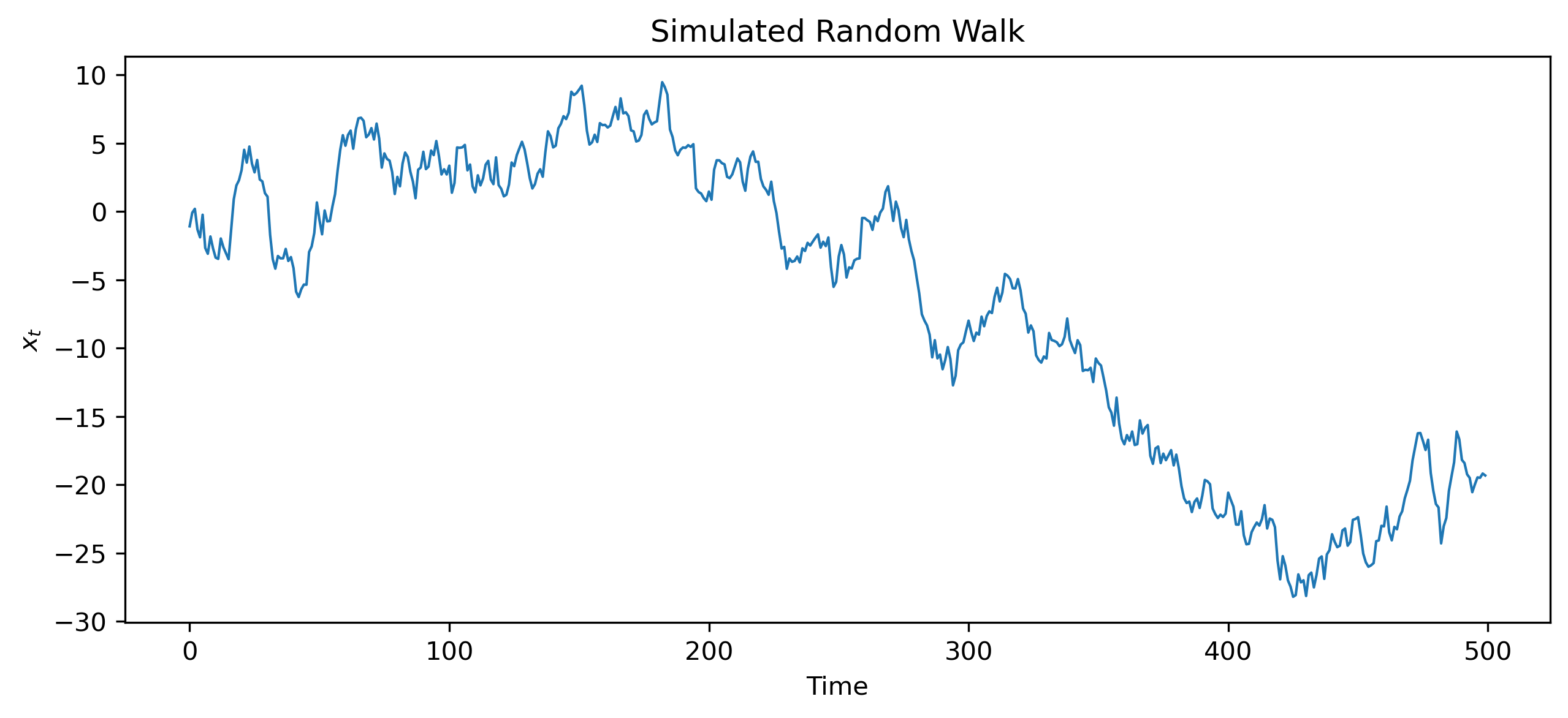
8.9 Why Random Walks Are Nonstationary
A random walk violates stationarity because:
shocks accumulate over time
variance grows continuously
no stable long-run mean exists
Variance of a Random Walk
Recall:
Therefore:
This violates weak stationarity.
8.10 Stationary vs Nonstationary Series
| Feature | Stationary | Nonstationary |
|---|---|---|
| Mean stable | Yes | Not necessarily |
| Variance stable | Yes | Often no |
| Dependence stable | Yes | Often no |
| Shocks temporary | Usually | Often persistent |
8.11 Trend Stationary vs Difference Stationary
Not all nonstationary series behave in the same way.
Trend-Stationary Processes
Some series fluctuate around a deterministic trend:
where is stationary.
Removing the trend leaves a stationary process.
Difference-Stationary Processes
Other series become stationary only after differencing.
Random walks are the classic example.
8.12 Why Stationarity Matters for Forecasting
Forecasting relies heavily on stable patterns.
For stationary processes:
dependence structure is stable
past relationships remain informative
For nonstationary processes:
statistical properties evolve over time
prediction becomes more difficult
8.13 Why Stationarity Matters for Regression
Nonstationary variables can create misleading statistical relationships.
Two unrelated trending variables may appear strongly related.
This problem is called:
We study this in detail later in latter chapters.
8.14 Looking Ahead
In this chapter, we introduced the idea of stationarity and saw how random walks violate it.
In the next chapter, we study:
autocorrelation
autocovariance
partial autocorrelation
which help us understand dependence structures in stationary time series.
Key Takeaways
Concept Check
Basic
What is stationarity?
What does it mean for the mean of a series to be constant?
What does it mean for the variance to be constant?
Intuition
Why is stationarity important in time series analysis?
What happens if a series is not stationary?
Why are many financial price series not stationary?
Intermediate
What is the difference between:
a stationary series
a nonstationary series
What is mean reversion?
Why does a random walk violate stationarity?
Finance Insight
Why are returns often more stationary than prices?
Why is stationarity important for forecasting models?
Challenge
Suppose a series shows an upward trend but stable fluctuations around that trend.
Is this series stationary?
What transformation might help?
Interpretation & Practice
A time series fluctuates around a constant level with no visible trend.
Is this likely stationary?
Why?
A time series shows a steady upward trend.
What does this suggest about stationarity?
Why might this cause problems for modeling?
A series has increasing variability over time.
What assumption of stationarity is violated?
Why does this matter?
A random walk is plotted.
Why does it appear to “wander” without returning to a fixed level?
What does this imply about persistence?
A differenced series appears to fluctuate around zero.
What does this suggest about stationarity?
Why is differencing useful?
Finance Interpretation
A stock price series shows a strong upward trend.
Why is this likely nonstationary?
Why are returns preferred for modeling?
A return series appears stable over time.
What does this suggest about stationarity?
Why is this useful in practice?
Challenge
A model is estimated using nonstationary data.
What kind of misleading results might occur?
Why is this dangerous?
Numerical Practice
Identifying Stationarity
Consider the following series:
Series A:
2, −1, 1, −2, 0, 1, −1Series B:
10, 12, 15, 18, 22, 27, 33
Which series appears stationary?
Which appears nonstationary?
Why?
Mean and Variance
Suppose a series behaves as follows:
First half: values fluctuate around 10
Second half: values fluctuate around 20
Is the mean constant?
Is the series stationary?
Suppose a series shows:
small fluctuations early
large fluctuations later
What property of stationarity is violated?
Differencing
Consider the series:
100, 102, 105, 109, 114
Compute the first differences
Does the differenced series appear more stable?
Suppose a random walk is defined as:
What would the differenced series look like?
Why is this important?
Challenge
Suppose a series has:
constant mean
constant variance
but strong dependence over time
Can it still be stationary?
Why?
Suppose you incorrectly treat a nonstationary series as stationary.
What type of errors might arise in modeling?