Chapter 14 — ARIMA Models
In the previous chapters, we studied:
autoregressive (AR) models
moving average (MA) models
ARMA models
These models assume that the underlying process is stationary.
However, many economic and financial time series are not stationary.
Examples include:
stock prices
GDP
exchange rates
price indices
These series often exhibit:
trends
persistent drift
unit roots
The solution is to transform the data before modeling.
Learning Objectives
By the end of this chapter, you should be able to:
understand the motivation behind ARIMA models
distinguish stationary and integrated processes
understand the role of differencing
define ARIMA() models
interpret the Box–Jenkins workflow
estimate ARIMA models in Gretl
evaluate residual diagnostics and model fit
14.1 Why ARIMA Models?
Many real-world time series exhibit strong persistence and nonstationarity.
For example:
stock prices drift over time
GDP tends to grow
inflation may exhibit persistent trends
Applying stationary ARMA models directly to such data may produce misleading results.
14.2 Differencing Revisited
Recall the first difference operator:
Differencing removes persistent stochastic trends.
Example: Random Walk
Suppose:
Then:
which is white noise.
14.3 Integrated Processes
First Difference
Second Difference
or:
14.4 The ARIMA Model
General Form
After differencing times:
where:
is the AR polynomial
is the differencing operator
is the MA polynomial
14.5 Understanding the Components
AR Component
Captures persistence through past values.
I Component
Captures nonstationarity through differencing.
MA Component
Captures temporary propagation of shocks.
14.6 Example: ARIMA(0,1,0)
Consider:
or:
Thus:
14.7 Example: ARIMA(1,1,0)
Suppose:
or equivalently:
14.8 Example: ARIMA(0,1,1)
Suppose:
Then:
14.9 Simulating an ARIMA Process
import numpy as np
import matplotlib.pyplot as plt

np.random.seed(123)

n = 400

phi = 0.7

w = np.random.normal(size=n)

dx = np.zeros(n)

for t in range(1,n):
    dx[t] = phi*dx[t-1] + w[t]

x = np.cumsum(dx)

fig, ax = plt.subplots(2,1, figsize=(10,6))

ax[0].plot(dx)
ax[0].set_title("Differenced Series")

ax[1].plot(x)
ax[1].set_title("Integrated Series")

plt.tight_layout()

plt.savefig("figs/ch14/ARIMA.png", dpi=300, bbox_inches="tight")
plt.close()   # replace with plt.show()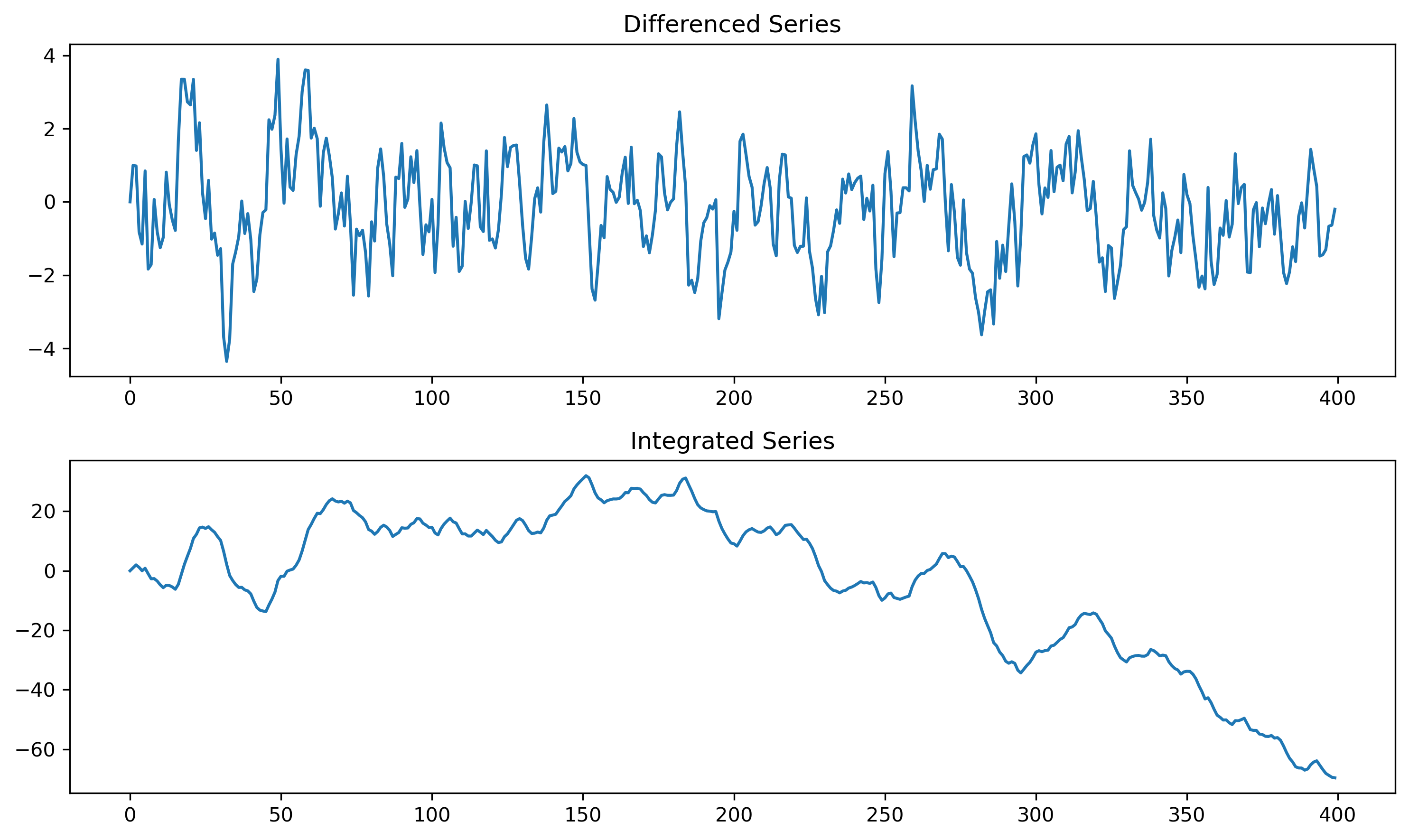
14.10 The Box–Jenkins Methodology
Classical ARIMA modeling follows the Box–Jenkins approach.
Step 1 — Identification
plot the data
check stationarity
difference if necessary
examine ACF/PACF
Step 2 — Estimation
Estimate candidate ARIMA models.
Step 3 — Diagnostic Checking
Check whether residuals resemble white noise.
Step 4 — Forecasting
Generate forecasts and evaluate performance.
14.11 Identifying Differencing Order
A series may require differencing if:
it exhibits persistent trends
ACF decays very slowly
unit root tests fail to reject nonstationarity
14.12 Under-Differencing vs Over-Differencing
Under-Differencing
residual nonstationarity remains
strong persistence persists
Over-Differencing
introduces excess noise
may create artificial negative autocorrelation
14.13 ACF and PACF in ARIMA Modeling
After differencing:
examine ACF
examine PACF
identify possible AR and MA orders
Typical Patterns
| Model | ACF | PACF |
|---|---|---|
| AR() | tails off | cuts off |
| MA() | cuts off | tails off |
| ARMA() | tails off | tails off |
14.14 Estimation in Gretl
Menu
Model → Time Series → ARIMATypical Workflow
plot the series
test for unit roots
difference if needed
inspect ACF/PACF
estimate candidate models
compare AIC/BIC
check residuals
[GRETL Screenshot Placeholder: ARIMA estimation dialog][GRETL Screenshot Placeholder: ARIMA output]14.15 Residual Diagnostics
Residuals should resemble white noise.
Residual ACF
import statsmodels.api as sm
from statsmodels.graphics.tsaplots import plot_acf

model = sm.tsa.ARIMA(x, order=(1,1,0))
res = model.fit()

plot_acf(res.resid, lags=20)

plt.savefig("figs/ch14/acf.png", dpi=300, bbox_inches="tight")
plt.close()   # replace with plt.show()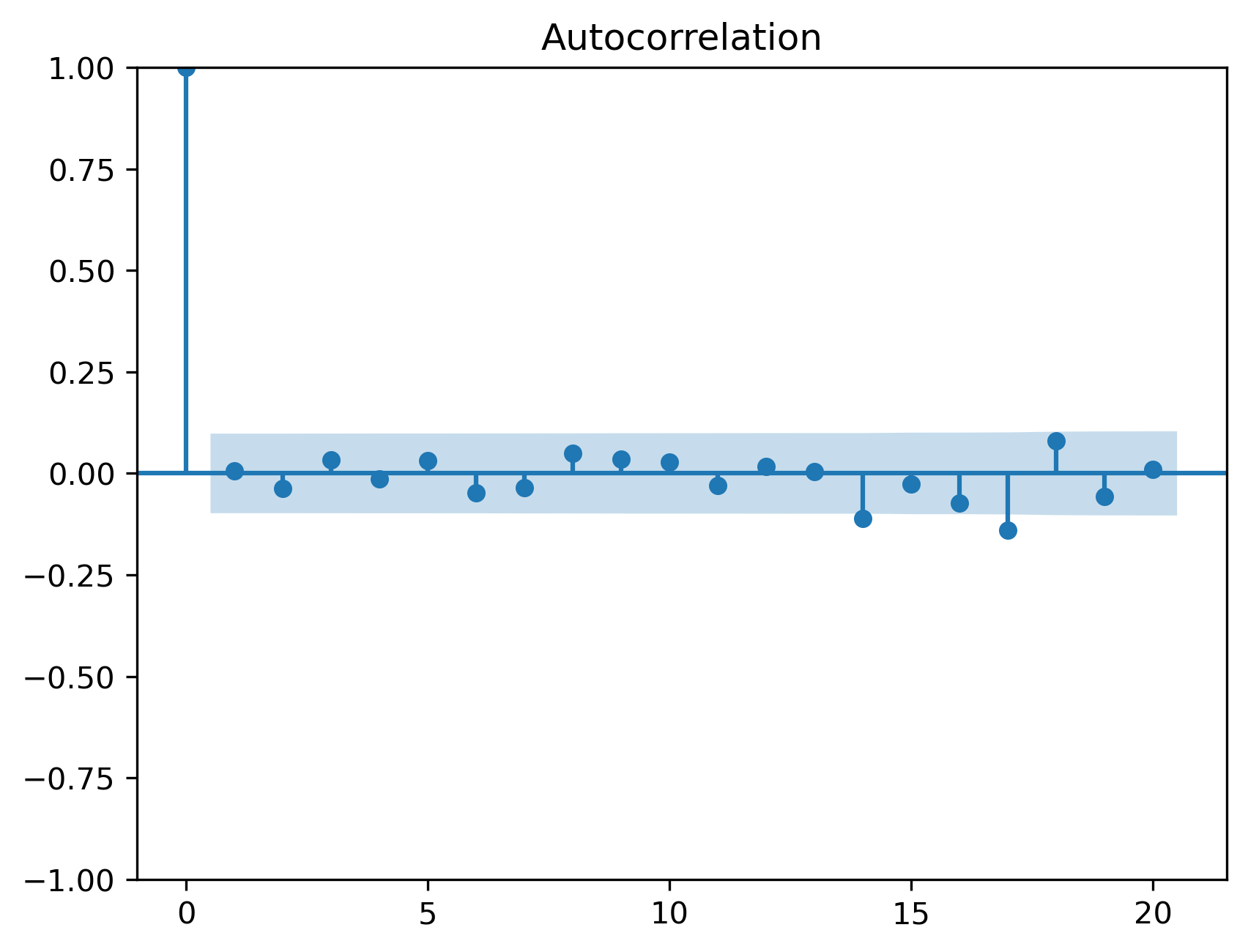
Ljung–Box Test
from statsmodels.stats.diagnostic import acorr_ljungbox

acorr_ljungbox(res.resid, lags=[10,20], return_df=True)
| | lb_stat | lb_pvalue |
|---------|------------|-----------|
| 10 | 4.729113 | 0.908524 |
| 20 | 25.169131 | 0.195037 |
14.16 Information Criteria
Model selection often uses:
AIC
BIC
Akaike Information Criterion
Bayesian Information Criterion
14.17 Forecasting with ARIMA Models
Once estimated, ARIMA models can generate forecasts.
Multi-Step Forecasts
Forecasts are generated recursively using:
past observations
estimated parameters
projected future dynamics
14.18 ARIMA Models in Economics and Finance
ARIMA models are widely used for:
GDP forecasting
inflation forecasting
demand forecasting
exchange rates
inventory management
energy consumption
14.19 Common Mistakes
14.20 Looking Ahead
In this chapter, we extended ARMA models to handle nonstationary series through differencing.
We now move to forecasting and forecast evaluation, where we study:
static vs dynamic forecasting
forecast accuracy
RMSE, MAE, MAPE
Theil’s U statistics
Key Takeaways
Concept Check
Basic
What is an ARIMA model?
What does the “I” in ARIMA represent?
What does differencing do to a time series?
Intuition
Why are many economic time series nonstationary?
Why is it problematic to apply ARMA models to nonstationary data?
What is the idea behind transforming data before modeling?
Intermediate
What does it mean for a series to be:
What is the difference between first and second differencing?
Why is most real-world data rather than ?
ARIMA Structure
What do , , and represent in ARIMA()?
What happens after differencing is applied?
Challenge
Suppose a series becomes stationary after differencing once.
What does this imply?
Interpretation & Practice
A time series shows a strong upward trend.
What transformation might be needed?
After differencing, the series fluctuates around zero.
What does this suggest?
A series exhibits very slow ACF decay.
What does this indicate?
After differencing, ACF shows AR-type behavior.
What does this suggest?
A series still appears nonstationary after differencing once.
What might you do next?
Finance Interpretation
Stock prices are nonstationary.
Why are returns preferred for modeling?
A return series appears stationary.
Why is this useful?
Challenge
A model fits well but uses .
Why might this be problematic?
Model Selection (AIC & BIC)
Suppose you estimate two ARIMA models:
| Model | AIC | BIC |
|---|---|---|
| ARIMA(1,1,1) | 520 | 540 |
| ARIMA(2,1,2) | 510 | 560 |
Which model is preferred according to AIC?
Which model is preferred according to BIC?
Why might these criteria disagree?
Suppose you estimate:
| Model | AIC | BIC |
|---|---|---|
| ARIMA(1,1,0) | 600 | 610 |
| ARIMA(3,1,2) | 590 | 640 |
Which model has better fit?
Which model penalizes complexity more?
Which would you choose, and why?
Explain the intuition behind:
What does the first term measure?
What does the second term penalize?
Why does BIC typically select simpler models than AIC?
Interpretation
A model has very low AIC but performs poorly out-of-sample.
What might be happening?
Why is model validation important?
Challenge
Suppose you keep adding lags to improve fit.
What happens to AIC?
What happens to BIC?
Why is this important for model selection?
Numerical Practice
Differencing
Given:
Compute
Compute second differences.
Identification
Suppose:
ACF decays slowly
series trends
What transformation is needed?
Suppose after differencing:
ACF cuts off after lag 1
What model is suggested?
Model Structure
Interpret:
What is being modeled?
Diagnostics
Residuals still show autocorrelation.
What does this imply?
Challenge
Suppose you over-difference a series.
What happens?
Why is this problematic?
Appendix 14A — Understanding Differencing and Integration
A.1 First Difference
This removes linear stochastic trends.
A.2 Random Walk Example
Then:
A.3 Second Difference
Used for stronger nonstationarity.
A.4 Why Differencing Works
Nonstationary series accumulate shocks:
Differencing removes this accumulation: