Chapter 11 — Autoregressive Models
In previous chapters, we studied:
stationarity
autocorrelation
persistence
unit roots and differencing
We are now ready to build formal stochastic models for stationary time series.
One of the most important and widely used classes of models is the autoregressive (AR) model.
Many economic and financial variables adjust gradually rather than instantaneously. Inflation, unemployment, interest rates, exchange rates, and GDP growth all tend to exhibit inertia or persistence.
Autoregressive models capture this gradual adjustment process mathematically.
Learning Objectives
By the end of this chapter, you should be able to:
understand the logic of autoregressive models
define AR() processes
interpret persistence
understand stationarity conditions
interpret ACF and PACF patterns
simulate AR models
estimate simple AR models
perform basic diagnostics
11.1 The Basic Idea
A simple model is:
where:
is the current value
measures persistence
is white noise
11.2 The AR(1) Model
Mean
11.3 Mean-Centered Form
11.4 Recursive Representation (Key Insight)
By repeated substitution:
11.5 Stationarity
11.6 Simulation
Source
import numpy as np
import matplotlib.pyplot as plt

np.random.seed(123)

n = 300
w = np.random.normal(size=n)

phis = [0.2, 0.7, 0.95]

fig, ax = plt.subplots(3,1, figsize=(10,8))

for i, phi in enumerate(phis):

    x = np.zeros(n)

    for t in range(1,n):
        x[t] = phi*x[t-1] + w[t]

    ax[i].plot(x)
    ax[i].set_title(f"AR(1), phi={phi}")

plt.tight_layout()

plt.savefig("figs/ch10/persistence.png", dpi=300, bbox_inches="tight")
plt.close()   # replace with plt.show()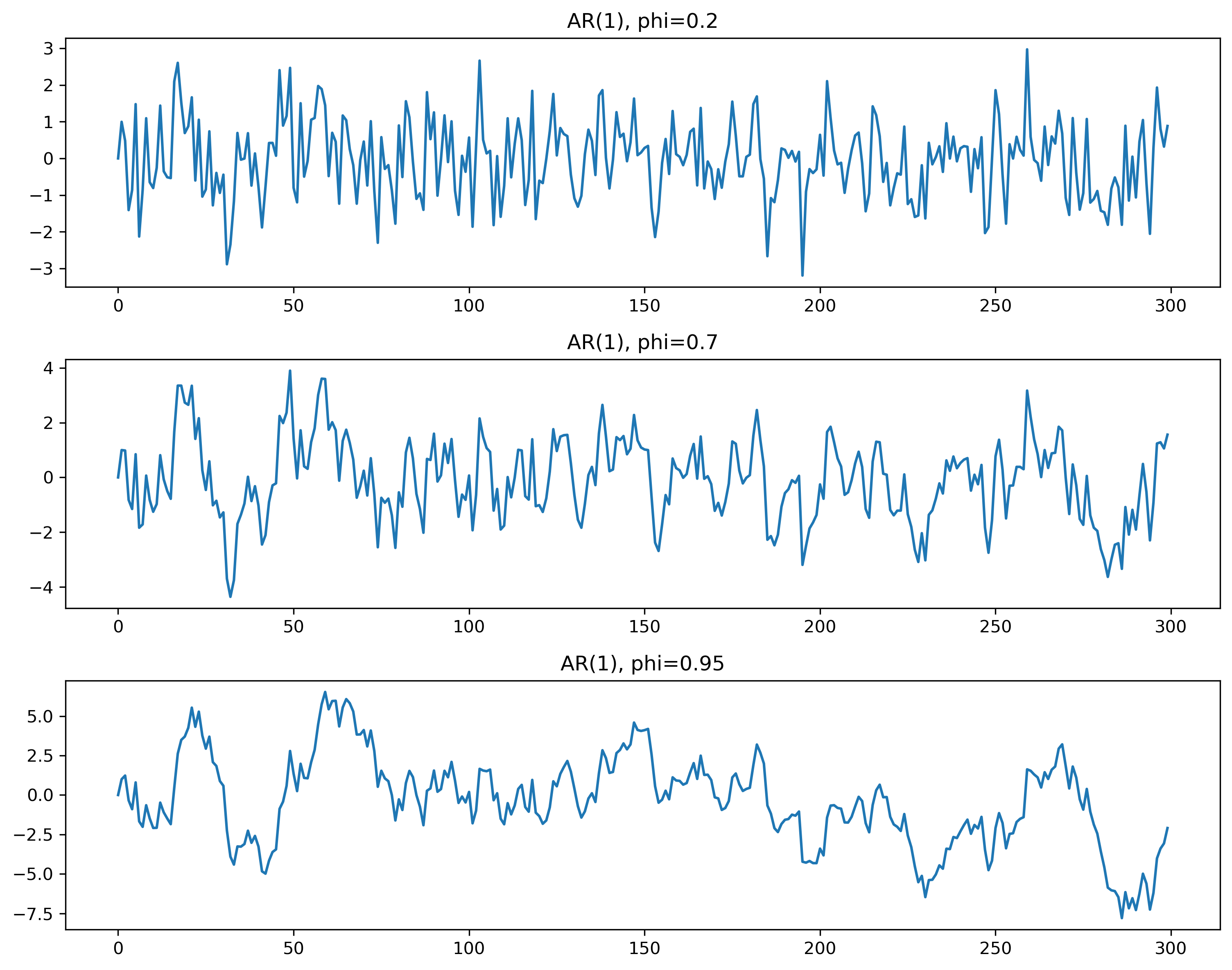
11.7 Variance
11.8 ACF of AR(1)
11.9 Simulated ACF
Source
from statsmodels.graphics.tsaplots import plot_acf

plot_acf(x, lags=30)

plt.savefig("figs/ch10/acf.png", dpi=300, bbox_inches="tight")
plt.close()   # replace with plt.show()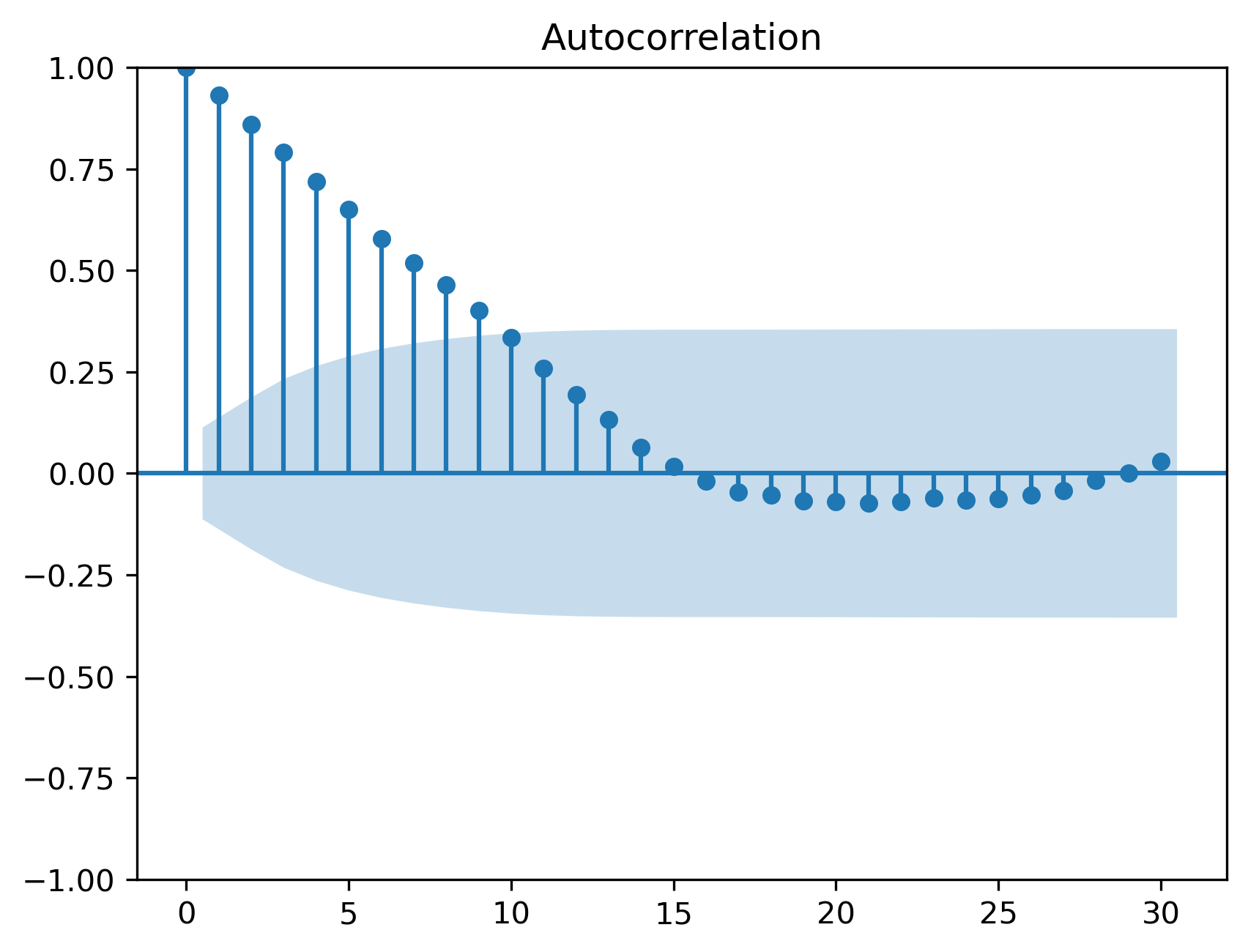
11.10 PACF of AR(1)
11.11 AR(2) Model
11.12 AR(2) Simulation
Source
np.random.seed(123)

phi1, phi2 = 1.0, -0.6
n = 1000

w = np.random.normal(size=n)
x = np.zeros(n)

for t in range(2,n):
    x[t] = phi1*x[t-1] + phi2*x[t-2] + w[t]

plt.plot(x)
plt.title("AR(2)")

plt.savefig("figs/ch10/ar2.png", dpi=300, bbox_inches="tight")
plt.close()   # replace with plt.show()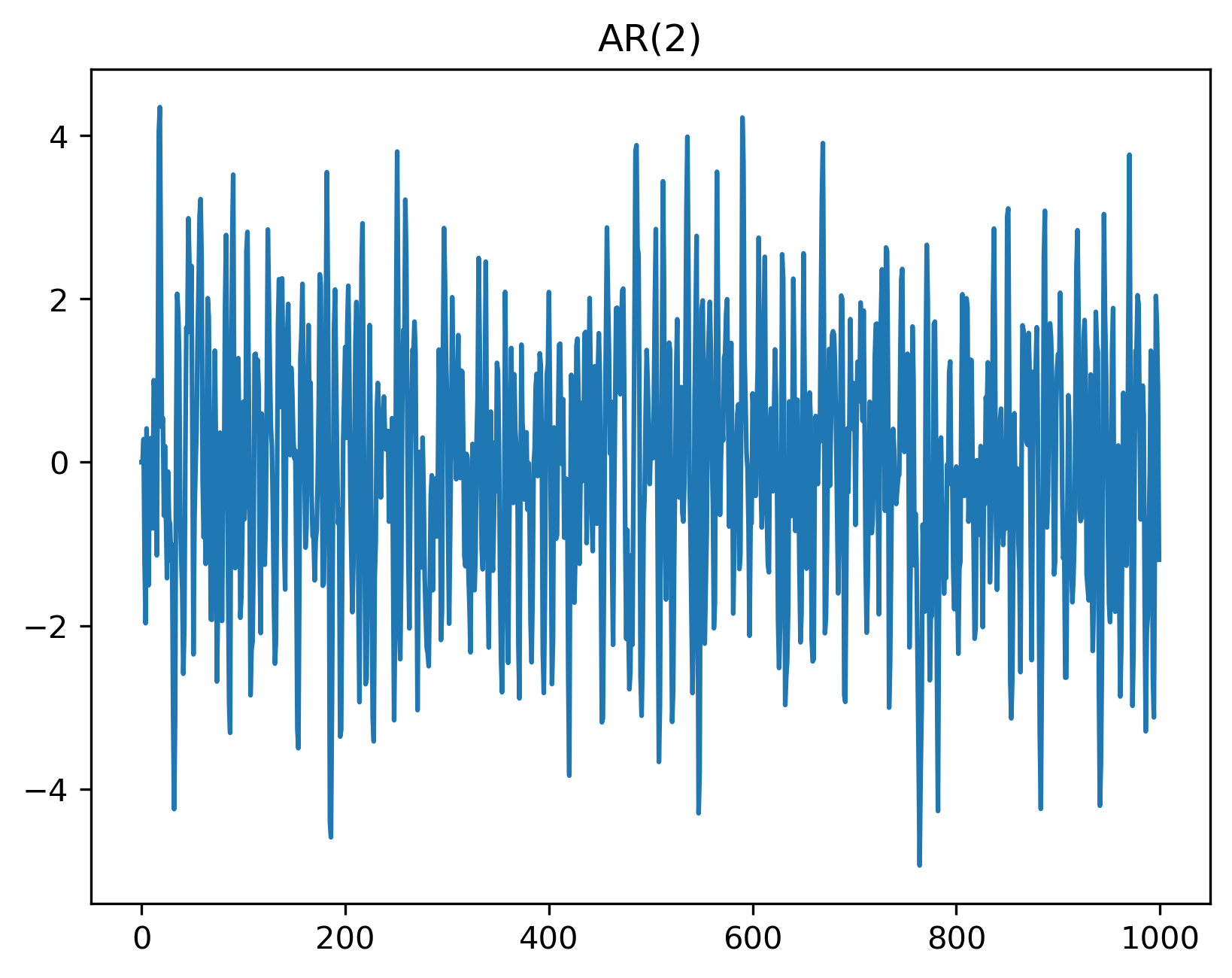
11.13 ACF and PACF for AR(2)
Source
from statsmodels.graphics.tsaplots import plot_pacf

plot_acf(x, lags=30)
plot_pacf(x, lags=30)

plt.savefig("figs/ch11/ar2_acf_pacf.png", dpi=300, bbox_inches="tight")
plt.close()   # replace with plt.show()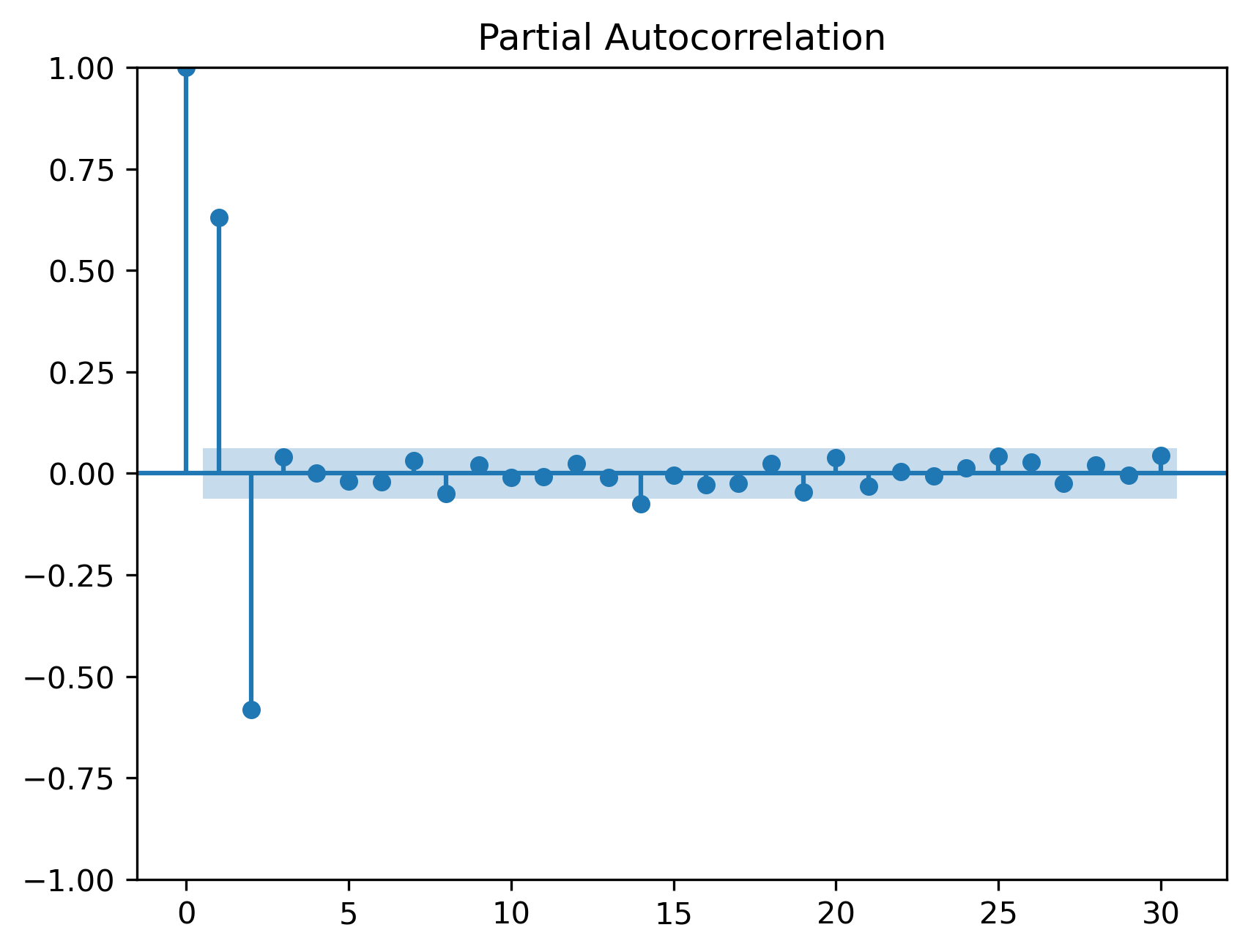
11.14 General AR(p)
11.15 Estimation in Python
Source
from statsmodels.tsa.ar_model import AutoReg

model = AutoReg(x, lags=2)
res = model.fit()

print(res.summary())
AutoReg Model Results
==============================================================================
Dep. Variable: y No. Observations: 1000
Model: AutoReg(2) Log Likelihood -1416.520
Method: Conditional MLE S.D. of innovations 1.000
Date: Mon, 04 May 2026 AIC 2841.040
Time: 21:40:24 BIC 2860.663
Sample: 2 HQIC 2848.499
1000
==============================================================================
coef std err z P>|z| [0.025 0.975]
------------------------------------------------------------------------------
const -0.0386 0.032 -1.218 0.223 -0.101 0.024
y.L1 1.0000 0.026 38.890 0.000 0.950 1.050
y.L2 -0.5850 0.026 -22.746 0.000 -0.635 -0.535
Roots
=============================================================================
Real Imaginary Modulus Frequency
-----------------------------------------------------------------------------
AR.1 0.8547 -0.9894j 1.3074 -0.1366
AR.2 0.8547 +0.9894j 1.3074 0.1366
-----------------------------------------------------------------------------11.16 Residual Diagnostics
Source
from statsmodels.stats.diagnostic import acorr_ljungbox

lb = acorr_ljungbox(res.resid, lags=[10,20], return_df=True)
lb
| | lb_stat | lb_pvalue |
|---------|------------|-----------|
| 10 | 6.476702 | 0.773750 |
| 20 | 18.268325 | 0.569737 |
11.17 Information Criteria
11.18 Common Mistakes
11.19 Looking Ahead
Next:
MA models
ARMA models
full modeling workflow
Key Takeaways
Concept Check
Basic
What is an autoregressive (AR) model?
What does the parameter represent in an AR(1) model?
What is the role of the error term ?
Intuition
What does it mean for a time series to exhibit persistence?
How does the value of affect the behavior of the series?
What happens when is:
close to zero
close to one
negative
Intermediate
What is the stationarity condition for an AR(1) model?
Why must shocks decay over time in a stationary process?
What is the difference between:
AR(1)
AR(2)
ACF & PACF
What pattern does the ACF of an AR(1) process exhibit?
What pattern does the PACF of an AR(1) process exhibit?
Why does the PACF “cut off” for an AR process?
Finance Insight
Why are AR models useful in modeling economic or financial time series?
Why is strong persistence sometimes mistaken for a trend?
Challenge
Suppose .
Is the process stationary?
How would it behave in practice?
Interpretation & Practice
A time series shows gradual adjustment after shocks.
What type of model might describe this?
Why?
A series appears highly persistent but does not trend upward.
What does this suggest about ?
Is the series likely stationary?
ACF decays slowly and smoothly.
What type of process might this indicate?
PACF shows a large spike at lag 1 and near zero afterward.
What model is suggested?
ACF shows a wavy, oscillating pattern.
What type of model might generate this?
After fitting an AR model, residuals still show autocorrelation.
What does this imply?
What should you do?
Finance Interpretation
A return series shows small but positive autocorrelation.
What does this imply about predictability?
Is this consistent with market efficiency?
A volatility series shows strong persistence.
Why might an AR-type structure be useful?
Challenge
A model fits the data well but produces poor forecasts.
What might be wrong?
What does this suggest about overfitting?
Numerical Practice
AR(1) Simulation Logic
Consider the AR(1) process:
with:
Compute
Repeat with:
Compare results
What changes?
Persistence
Suppose:
If , how quickly do shocks disappear?
If , how quickly do shocks disappear?
ACF Interpretation
Suppose you observe:
What pattern is this?
What does it suggest about ?
Model Identification
You observe:
ACF gradually decays
PACF cuts off after lag 2
What model is suggested?
Estimation Output
Suppose an estimated AR(1) model gives:
Is the series highly persistent?
Is it stationary?
What does this imply for forecasting?
Diagnostics
Suppose the residuals from an AR model show:
significant autocorrelation
What does this imply?
What should you do next?
Challenge
Suppose .
What happens to the process?
Why is this problematic?
Suppose you include too many lags in an AR model.
What is the risk?
How can information criteria help?
Appendix 11A — Mathematical Details of AR Models
This appendix provides additional insight into the properties of autoregressive models.
These results are not required for basic understanding, but they help explain why AR models behave the way they do.
A.1 Recursive Representation of AR(1)
Consider:
Substitute repeatedly:
Continuing:
A.2 Stationarity Condition
From the recursive form:
For this to converge, we require:
A.3 Mean of AR(1)
Consider:
Take expectations:
In equilibrium:
So:
A.4 Variance of AR(1)
From:
Take variance:
In steady state:
So:
A.5 Autocovariance Function
We define:
Multiply the AR(1) equation by :
Thus:
Iterating:
A.6 Autocorrelation Function
Since:
we obtain:
A.7 Yule–Walker Equation (AR(1))
At lag 0:
Rearranging:
This gives the variance result above.
A.8 AR(2): Intuition and Dynamics
Consider:
Unlike AR(1), this process can generate:
oscillations
cycles
damped fluctuations
A.9 Characteristic Equation
For AR(p):
We define the characteristic equation: